

- Oil Shock Sends Asian Markets Lower as Middle East Conflict Threatens Global Shipping |
- Trump Links Iran War to US Midterms, Backs United Ireland |
- PM Tarique Rahman Seeks Public Cooperation to Tackle Nationwide Dengue Outbreak |
- Jatiyatabadi Mahila Dal Vows to Lead Fight Against Rape, Violence Against Women and Children |
- 'Honorable' Dropped: PM Starts Implementing Decision from His Own Office |
The Philosopher-King: Marcus Aurelius, the Roots of His Virtue, and the Accuracy of Historical Accounts
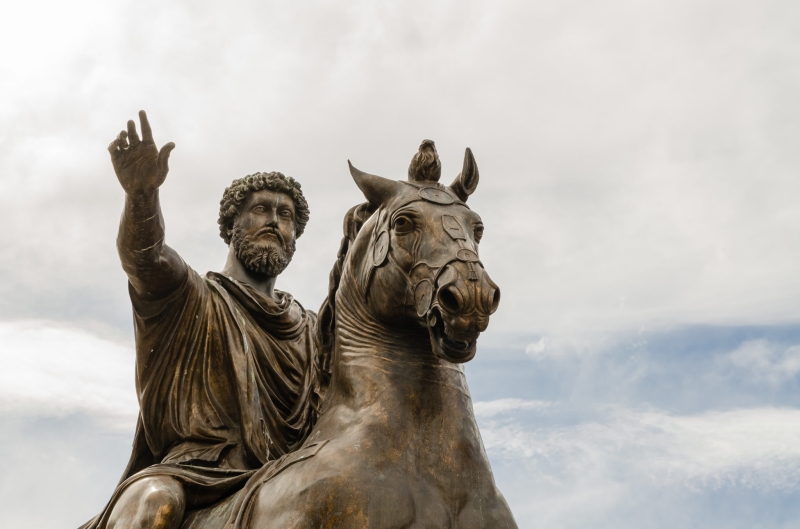
Image: Collected
History has known many absolute rulers, but few are remembered with the moral reverence accorded to Marcus Aurelius. Reigning over the Roman Empire from 161 to 180 CE, he was the last of the "Five Good Emperors" who presided over the Pax Romana. Rather than being corrupted by absolute power, he spent his life cultivating modesty, duty, and self-restraint. Understanding Marcus Aurelius requires exploring both the forces that shaped his remarkable commitment to virtue and the historical reliability of the accounts detailing his life.
What Caused Marcus Aurelius to Have Virtue?
The virtue of Marcus Aurelius was neither an accident of birth nor a performance for the public; it was the result of deliberate education, intentional mentorship, rigorous personal discipline, and the trial of immense responsibility.
Formative Upbringing and Early Mentorship
Marcus was born into an aristocratic family, but he lost his father at a young age. He was raised primarily by his mother, Domitia Calvilla, and his grandfather, Marcus Annius Verus. In his private journal, Meditations, Marcus systematically thanks the people who shaped his character. From his mother, he learned piety, generosity, and abstaining from evil thoughts. From his grandfather, he inherited a modesty of character and a sweet temper.
His intellect and serious disposition caught the eye of Emperor Hadrian, who playfully nicknamed the young boy Verissimus, meaning "the most truthful". Hadrian ensured Marcus received an exceptional education, surrounding him with premier tutors in rhetoric, law, and philosophy.
The Influence of Stoic Philosophy
While Marcus studied rhetoric under Marcus Cornelius Fronto, his true passion lay in philosophy. One mentor stood above the rest: Quintus Junius Rusticus. Rusticus introduced Marcus to the teachings of Epictetus, a former slave turned prominent Stoic philosopher. Stoicism taught Marcus to focus strictly on what was within his control—his thoughts, actions, and character—while accepting external events with composure. It instilled in him a duty to serve the common good as a member of a global community, treating philosophy not as abstract theory, but as an active daily practice of self-regulation.
The Model of Antoninus Pius
In 138 CE, Emperor Antoninus Pius adopted Marcus as his heir. For over two decades, Marcus observed Antoninus govern. In Meditations, Marcus gives a glowing account of his adoptive father: a man who was unpretentious, firm in decision-making, indifferent to hollow flattery, and entirely devoted to the public good. Antoninus provided Marcus with a living template of what a virtuous ruler looked like in practice.
Forged in Adversity
Virtue is tested in crisis, and Marcus Aurelius faced an extraordinary number of them. His reign was hit by the Antonine Plague, a catastrophic pandemic that devastated the Roman population. He endured the Marcomannic Wars, spending decades in grueling military campaigns along the Danubian frontier. On a personal level, he buried eight of his fourteen children. Rather than growing bitter, Marcus used these hardships to practice Stoic acceptance, maintaining composure and putting his duty to Rome above personal peace.
How Historically Accurate Are the Accounts of Marcus Aurelius?
Evaluating historical accounts of Marcus Aurelius requires analyzing his own private writings, contemporary host records, and later ancient biographies.
Private Reflections: Meditations
The most famous source for Marcus's life is Meditations, originally titled To Himself. This source carries exceptionally high accuracy because it was never intended for publication. It consists of private journal entries written late at night in military camps along the Danube. Because Marcus was writing purely to himself, he had no reason to manufacture a public persona or exaggerate his accomplishments. It reveals a vulnerable human struggling against fatigue, frustration with incompetence, and grief, continuously reminding himself to remain patient, just, and humble.
Contemporary Histories: Cassius Dio
Cassius Dio was a Roman senator who lived through Marcus's reign. As a contemporary observer, Dio had access to official state records and firsthand accounts. His work holds high factual accuracy regarding military and political events. Dio held Marcus in high regard, famously writing that Marcus's death marked a transition "from a kingdom of gold to one of iron and rust." While his historical timeline is verified by archaeology, his moral praise reflects the political idealization common in senatorial histories.
Later Biographies: Historia Augusta
The Historia Augusta is a late fourth-century collection of imperial biographies with mixed reliability. Modern scholars recognize that large portions of the text were fabricated by a single author who invented sources and sensational anecdotes. However, the section specifically titled Life of Marcus Antoninus relied on lost earlier works, making it relatively reliable for major dates, administrative appointments, and political milestones, even if specific dialogue remains suspect.
Private Correspondence: Letters with Fronto
Discovered in the nineteenth century, the surviving letters between Marcus Aurelius and his former teacher Fronto span several decades. These unedited, informal letters carry high historical accuracy. They reveal Marcus as a young prince and mature emperor, confirming his devotion to his studies, his deep emotional ties to family, and his heavy administrative workload. These letters directly corroborate the personal character drawn by Dio and Meditations.
Unlike many historical figures whose legends were inflated by state propaganda, Marcus Aurelius’s reputation for virtue stands on remarkably solid ground. The close alignment between his private reflections in Meditations and independent external sources confirms that his virtue was not a political facade, but a lifelong practice forged through philosophy, duty, and resilience.