

- 35 Australian-Based Bangladeshi Journalists Demand Immediate Release of Senior Media Leader Iqbal Sobhan Chowdhury |
- Six killed, 17 injured in mass shooting in Poland’s Krakow |
- BGB sets up security across industrial areas after garment protests |
- Actress Samira Khan Mahi Crowned 'Miss Universe Bangladesh 2026' |
- We must work together to resist anti-national conspiracies |
From Broken Chips to a Global Empire: The Engineering Evolution of Pringles
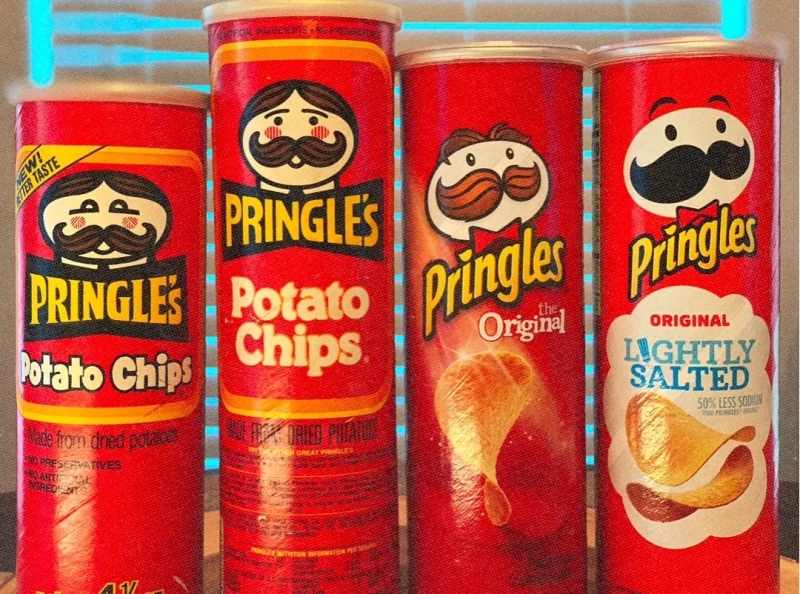
Image: Collected from Rerun the 80s on Facebook
In the mid-1950s, Procter & Gamble set out to fix a problem that plagued the snack food industry: traditional potato chips were greasy, went stale quickly, and broke easily inside air-filled bags. What started as a complaint about crushed snack food evolved into one of the most sophisticated engineering achievements in mass-produced food.
The Engineering Breakthrough
Creating a stackable, uniform chip required solving two distinct challenges: the shape of the chip and the vessel that would protect it.
1. The Perfect Geometry
P&G chemist Organic Chemist Fredric J. Baur calculated that the optimal shape for stackability and structural integrity was a hyperbolic paraboloid—a three-dimensional saddle shape. This geometry ensures:
● Aerodynamic stability: The chips don't break during high-speed production or transit.
● Uniform stacking: Every chip fits tightly against the next without slipping.
● Resistance to force: The curve distributes pressure evenly, preventing fracture.
2. The Flavor Formula
While Baur perfected the shape, he struggled to make them taste good. In the late 1960s, researcher Alexander Liepa developed a dry potato dough—made from dehydrated potato flakes, cornstarch, and wheat starch—that could be pressed into molds and fried quickly.
3. The Iconic Can
Baur also engineered the famous foil-lined cardboard cylinder with a plastic re-sealable top. The packaging flushed out oxygen to keep the crisps fresh and structurally intact, eliminating the need for bulky, air-puffed bags. Baur was so proud of his invention that when he passed away in 2008, his family buried a portion of his cremated remains inside a Pringles container.
Key Milestones in Pringles History
● The Patent and Launch
1956–1968
P&G began development in 1956. By 1968, "Pringle's Newfangled Potato Chips" debuted in test markets across the United States.
● National Expansion & Legal Debates
1975
Pringles rolled out nationwide across the US. However, trade groups argued that because Pringles were made from potato dough rather than sliced potatoes, they could not legally be called "chips." P&G eventually rebranded them as potato crisps.
● Global Reach & Mascot Evolution
1990s
Pringles expanded into Europe, Asia, and Latin America. The brand's mascot, Julius Pringle, underwent several modernizations, streamlining his signature mustache and bow tie.
● Acquisition by Kellogg's
2012
Kellogg's (later Kellanova) acquired Pringles from Procter & Gamble for $2.7 billion, solidifying its place as a global snack power with distribution in over 140 countries.
Flavor Innovation and Modern Legacy
Pringles shifted from a structural miracle into a cultural icon by leveraging its uniform shape. Because every crisp is identical, seasoning could be applied with high precision using specialized dusting machines.
This consistency allowed the brand to experiment beyond standard salty or sour flavors, launching hyper-localized and viral variations around the world—from Pizza and Sour Cream & Onion in North America to Wasabi, Ramen, and Prawn Cocktail in international markets.
Today, Pringles stands as an example of how industrial design and food science combined to transform a fragile staple into an instantly recognizable global brand.