

- Arson Attempt Foiled as Staff Quench Fire on Mirpur Bus |
- Personalized mRNA Melanoma Vaccine Intismeran Hits Major Milestone, Cutting Recurrence Risk by 42% in Landmark Phase 3 Trial |
- City govt essential for planned development of Chattogram: CCC administrator |
- Asian Stocks Slump After US Tech Rout Amid AI Jitters |
- Free Concert Featuring James and Seven Bands Set for Manik Mia Avenue |
The Man Out of Time: A Hero Caught Between Two Eras
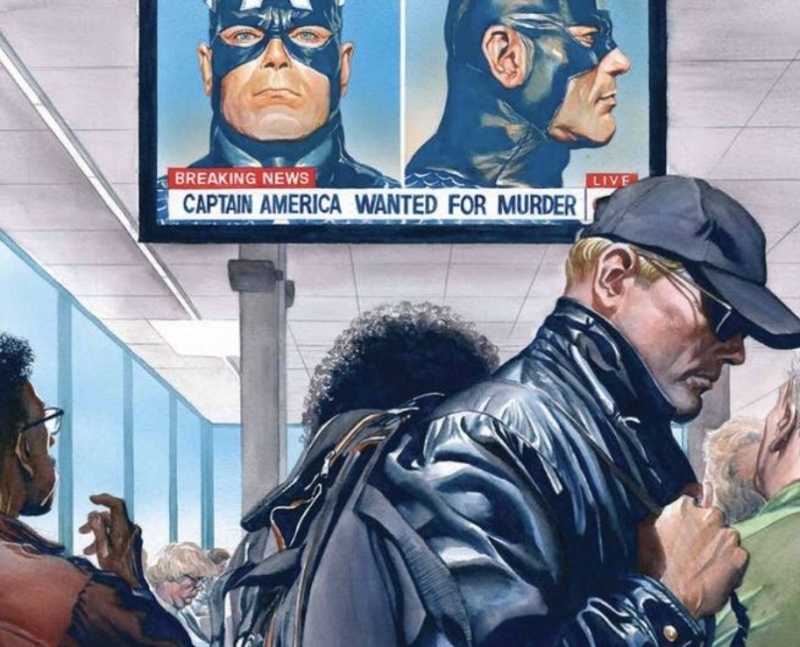
Image: Collected
Captain America was born in an era defined by war, patriotism and sacrifice. Steve Rogers was a young man from Brooklyn who wanted nothing more than to serve his country during World War II. Physically weak but determined to do his part, he was transformed into a super-soldier and became one of the most recognizable symbols of the Allied fight against Nazi Germany.
But Captain America’s greatest challenge was never fighting an enemy.
It was surviving a future he was never supposed to see.
After being lost in the ice for decades, Steve Rogers awakened in a world that had moved on without him. The streets were different, the technology was unfamiliar, the people he once knew were gone, and the values of the society around him had changed. He had physically survived the passage of time, but emotionally he remained connected to the world of the 1940s.
That is what makes Captain America more than simply a patriotic superhero. He is a man out of time.
Steve's displacement is introduced almost immediately after he awakens in the modern world. Everything he remembers belongs to another era. The war is history. His friends have aged or died. The life he imagined for himself disappeared while he was frozen.
Yet Steve does not spend his life trying to recreate the past.
Instead, he tries to understand the present.
This distinction is central to his character. Captain America represents certain ideals—courage, responsibility, loyalty and the willingness to stand up for ordinary people—but he is not simply a character who believes that the past was better. His journey is about discovering how those ideals can survive in a changing world.
The modern world also forces Steve to question institutions he once trusted.
The America he remembered from the 1940s was imperfect, but his understanding of duty was comparatively simple: identify the threat and fight it. In the present, however, the lines are much less clear. Governments can make mistakes. Intelligence agencies can be infiltrated. Powerful organizations can operate in secret. Even people fighting under the American flag can become threats to the very principles they claim to protect.
This conflict becomes particularly important in Captain America: The Winter Soldier. Steve discovers that S.H.I.E.L.D. has been compromised by HYDRA and is forced to confront a terrifying possibility: blindly following authority is not the same thing as serving one's country.
For Steve, patriotism becomes less about obedience and more about principles.
That is one of the reasons his character has remained relevant across different eras of Marvel storytelling. The costume, shield and symbolism may immediately suggest American nationalism, but Steve Rogers himself is often at his most interesting when he questions what those symbols are supposed to represent.
His greatest strength is therefore not simply his enhanced physical ability.
It is his willingness to resist.
Steve is willing to stand against an enemy, a government, an organization or even his closest allies when he believes that something fundamental is wrong. His sense of morality comes from a time when his world was very different, but he gradually learns that doing the right thing cannot always mean following the rules.
At the same time, being a man out of time gives Steve a deep sense of loneliness.
He is surrounded by people, yet few can truly understand what he has lost. He remembers a world that exists only in photographs and history books. Even when he forms new friendships with people such as Natasha Romanoff and Sam Wilson, there remains a part of him that belongs to another century.
His relationship with Bucky Barnes makes this feeling even more powerful.
Bucky is not simply Steve's childhood friend. He is a living connection to the life Steve lost. When Steve discovers that Bucky has survived but has been transformed into the Winter Soldier, his past suddenly becomes part of his present again.
Steve refuses to see Bucky merely as an enemy.
He sees the person underneath the conditioning.
That decision reflects one of Captain America's defining characteristics: his refusal to abandon people simply because circumstances have changed.
Steve's relationship with Peggy Carter carries a different kind of sadness. Peggy represents the future Steve expected to have before he disappeared beneath the ice. When he finally sees her decades later, he is confronted with the reality that time continued without him.
There is no villain to defeat in that moment.
There is simply time.
And Steve cannot fight time.
This is what makes the concept of the "man out of time" so emotionally powerful. Captain America can defeat super-soldiers, aliens and powerful organizations, but he cannot recover the decades he lost. He cannot bring back the people he loved. He cannot return permanently to the world he remembers.
His journey is therefore not about getting his old life back.
It is about finding a new reason to live.
By the time Steve Rogers reaches the later stages of his story, he has become something different from the young soldier who first entered the ice. He still carries the memories of the 1940s, but he has also experienced the complexity of the modern world. His understanding of justice has expanded beyond the simple categories of his youth.
Captain America remains a man out of time—but he is no longer trapped by it.
Perhaps that is the most important part of Steve Rogers' story. Being displaced from your own era does not mean that you have no place in the future. It means you have to find one.
Steve Rogers represents a bridge between generations. He carries the ideals of one period into another, while allowing those ideals to be challenged and reshaped by everything he experiences.
The shield becomes a symbol of that journey.
It is not merely a weapon. It represents something Steve carries forward from his past while using it to protect a world that is constantly changing.
Captain America may have been created as a soldier from the 1940s, but his story has never really been about staying in the past.
It has always been about moving forward.
Steve Rogers lost his time.
But he never lost himself.