

- Oil Shock Sends Asian Markets Lower as Middle East Conflict Threatens Global Shipping |
- Trump Links Iran War to US Midterms, Backs United Ireland |
- PM Tarique Rahman Seeks Public Cooperation to Tackle Nationwide Dengue Outbreak |
- Jatiyatabadi Mahila Dal Vows to Lead Fight Against Rape, Violence Against Women and Children |
- 'Honorable' Dropped: PM Starts Implementing Decision from His Own Office |
The Bengali Sailor Beyond the Pacific: The Humanitarian Personality Gama Abdul Kadir
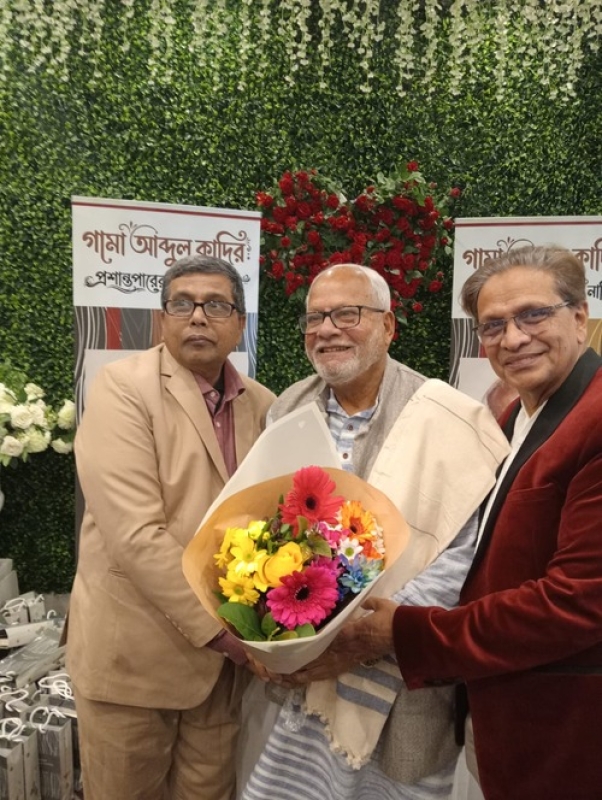
Photo: Bangolok
A publication event of the commemorative book *“Prashantparer Bangali Nabik: Gama Abdul Kadir”* (The Bengali Sailor Beyond the Pacific), highlighting the life and contributions of humanitarian personality Gama Abdul Kadir, was held in Sydney, Australia.
The event, held on July 31 at the Red Rose Function Centre in Rockdale, Sydney, turned into a gathering of expatriate Bangladeshis. The commemorative volume, featuring articles written by 55 authors on the 84-year-old Bengali personality from the Pacific region, was unveiled at the event.
The programme was organised as a unique initiative to preserve Bengali literature, history and cultural heritage among expatriate communities and became a memorable gathering for Bangladeshi Australians.
The event began with the national anthems of Australia and Bangladesh, creating a special atmosphere of respect for both countries.
Lawyer, writer and social worker S. M. Abraham Lincoln attended the event as the chief guest. Writer, rhymester, columnist and media personality Ajay Dasgupta delivered the keynote speech. The event was chaired by eminent educationist, journalist and social worker Professor Dr Sultan Mahmud.
Speakers at the event included New South Wales state parliamentarian Shaoquett Moselmane, lawyer Dr Sirajul Haque, Dr Abul Hasnat Milton, Atikur Rahman Shuvo and Al Noman Shamim.
The book was dedicated to William A. S. Ouderland (Bir Protik), the only foreign recipient of a military title for his contribution to Bangladesh’s Liberation War, and the three million martyrs who were victims of genocide during the war.
Speakers said that documenting the lives, struggles and contributions of individuals who have silently played remarkable roles in shaping the lives of expatriate Bangladeshis and their communities is a demand of the time.
They said the book *“Gama Abdul Kadir: Prashantparer Bangali Nabik”* is not merely a biography of an individual; rather, it is a record of the history of Bangladeshi migration to Australia, the development of the expatriate community and the sacrifices of a generation.
They also said many members of the new generation are unaware of how early Bangladeshi migrants established themselves despite limited opportunities and built a strong community. This book will bring that lesser-known history before the new generation.
The speakers further said Bengali language, literature and culture are not limited to Bangladesh alone; expatriate Bangladeshis living around the world are also preserving and carrying forward this heritage. Therefore, research and publications on expatriate history, culture and personalities will remain valuable resources for the future.
Prominent members of the Bangladeshi community, literary enthusiasts, journalists, cultural figures and people from different professions attended the publication event. The book was formally unveiled after the discussion session.
The author was greeted with flowers, while guests congratulated him with applause.
The programme was moderated by Tisha Tania and Purbie Parmita Bose. Later, a cultural programme featuring music, recitation and other performances was held, making the event lively and vibrant.
Gama Abdul Kadir: A Living History of the Expatriate Bangladeshi Community
The central figure of the book, Gama Abdul Kadir, is not only a community organiser but also a living history of the expatriate Bangladeshi society.
He was born on February 2, 1944, in Jalpaiguri, India. From his student life, he was involved in politics, mass movements and social welfare activities. He actively participated in the 1962 Education Movement, the 1966 Six-Point Movement, the 1969 Mass Uprising and also played an important role during the Liberation War of Bangladesh.
During the Liberation War, he was involved in the relief activities of the Red Cross in Kolkata and dedicated himself to humanitarian service.
After independence, he joined Holy Family Hospital as a paramedical officer. He began his professional career there as the first Muslim officer in the history of the hospital.
In 1974, he founded the Bangladesh Red Cross Employees League and served as the founding president of the organisation.
Following the political circumstances after the assassination of Bangabandhu Sheikh Mujibur Rahman, he eventually migrated to Australia. Even after moving abroad, he did not focus only on building his own life; rather, he played an important role in uniting scattered Bangladeshis into a strong community.
Under his leadership, the Bangladesh Association Australia was revitalised. He was elected president of the organisation five times and general secretary three times.
His contributions to establishing cultural activities in Sydney, including Bangladesh Mela, Bangla School, Ekushey Mela, Boishakhi Mela and Prabhat Pheri at the Shaheed Minar, remain memorable.
Beyond the Bangladeshi community, he also played important roles in initiatives such as the Islamic Cultural Centre, Puja Celebration Council and Friendship Fellowship, promoting interfaith and social harmony.
He was also one of the key organisers behind establishing Awami League, the Muktijoddha Sangsad and Bangabandhu Parishad among expatriate Bangladeshis.
During the 1980s, Gama Abdul Kadir stood beside many Bangladeshi migrants facing difficulties in Australia and set an example of humanitarian service. For many, his home became a shelter for distressed expatriates. As a result, community members lovingly called him “Friend in Crisis” and “Banyan Tree”.
In recognition of his long-standing contributions to humanitarian service, social leadership and multicultural community building, he received honours from various institutions, including the NSW Parliament.
The life story of Gama Abdul Kadir is not merely a personal success story; it is a unique history of struggle, patriotism, humanitarian service and the construction of a national identity abroad.
Comments from 55 Contributors in the Book
The book includes reflections and assessments from 55 individuals on Gama Abdul Kadir’s life, work and humanitarian contributions.
Among them are his wife Bindu Chowdhury, Fakhruddin Chowdhury, Shaoquett Moselmane, Dr Mohammad Abdur Razzaque, Dr Md Shamsuddin, Dr Saleh Uddin, Dr Abed Ali Mia, Dr Ali Kazi, Dr Renu Deb-Dash, Sohrab Hasan, Golam Mostofa, Ashish Bablu, Shafiqul Alam, Dr Md Sirajul Haque, Dr Azad Jahir, Dr Noor Rahman Khokon, Atikur Rahman Bhuiyan, Dr Abul Hasnat Milton, Dr Nargis Banu, Kaisar Ahmed, Dr Shakhawat Nayan, Lutfor Rahman Shawon, Abdul Jalil, Arifur Rahman, Dr Ratan Kundu, Dr Daud Hasan, A H Pinto, Monirul Haque George, Masud Chowdhury, Nancy Lina Barrel, Mohammad Rahmatullah, Dr Lovely Rahman, Happy Rahman, Eliza Azad Rahman, Atik Helal, Mohammad Abdul Matin, Sukur Khan, Tisha Tania, Dr Molla Haque, Purbie Parmita Bose, Kashfi Asma Alam, Ziaul Haque Bablu, Afrina Chowdhury, Suhrid Sohan, Bilkis Jahan, Kishwar Akhtar Kakoli, Shahjahan Baitalik, Laboni Akhter Lucky, Sagar Badrul Kadir, Raihana Siddika Roni, Al Noman Shamim, Rokeya Ahmed, Professor Dr Sultan Mahmud, S. M. Abraham Lincoln and Ajay Dasgupta.
In their reflections, they described Gama Abdul Kadir as a “pillar of support in times of crisis,” “a wise person in the diaspora,” “the banyan tree of Sydney,” “a silent source of light,” “a friend in difficult times” and “a shelter for expatriate Bengalis.”