

- City govt essential for planned development of Chattogram: CCC administrator |
- Asian Stocks Slump After US Tech Rout Amid AI Jitters |
- Free Concert Featuring James and Seven Bands Set for Manik Mia Avenue |
- Garment factories reopen as workers return to work in Savar-Ashulia |
- Trump confirms new US strikes on Iran’s Qeshm island |
The Obsession Over Skulls in Art
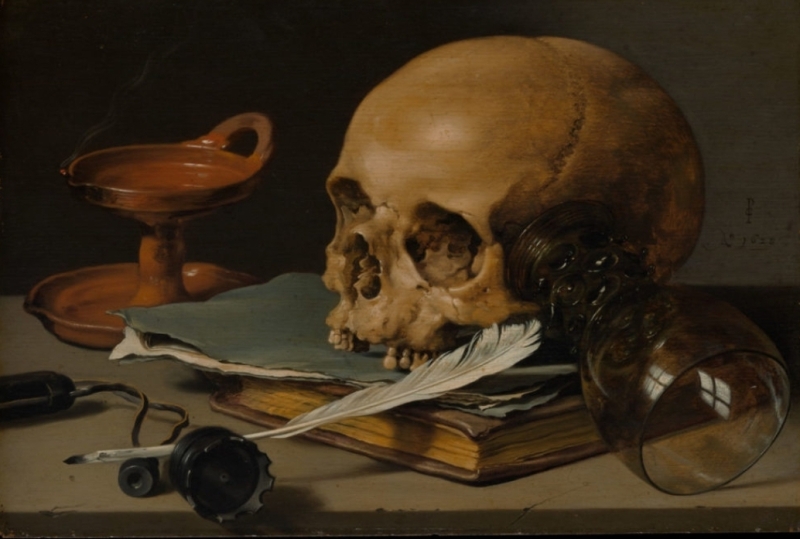
Image: Collected
Few images are as instantly recognizable or as strangely seductive as the human skull. It appears in medieval paintings, Dutch still lifes, punk posters, luxury fashion, tattoos, and contemporary installations. The skull’s persistence in art is not merely a taste for the macabre; it is an attempt to confront death, time, power, and the fragility of the human body.
A Mirror of Mortality
At its most basic, the skull is art’s most direct symbol of death. Unlike a corpse, which suggests decay and horror, the skull is clean, architectural, and almost abstract: a face reduced to its essential structure. That makes it ideal for artists who want to say something universal about human finitude.
In Western art, this role became especially powerful through memento mori—“remember that you must die.” Medieval and Renaissance artists used skulls to remind viewers that wealth, beauty, youth, and status are temporary.
Vanitas: Beauty Beside Decay
The skull reached one of its richest artistic forms in Dutch vanitas painting of the sixteenth and seventeenth centuries. These still lifes placed skulls beside flowers, fruit, candles, books, clocks, and luxurious objects. Each item carried a warning: flowers wilt, fruit rots, candles burn out, and knowledge or wealth cannot prevent death.
The effect is deliberately contradictory. The paintings are beautiful, but their beauty is designed to unsettle. A viewer admires the silk, silver, and ripe fruit—then notices the skull and realizes that all of it will disappear. In this sense, the skull is not simply an object of fear; it is a philosophical device that forces reflection on how one lives.
Death, Religion, and Power
Skulls also carry religious and political meanings. In Christian art, they often appear near saints, hermits, Mary Magdalene, or the Crucifixion, linking mortality to repentance and salvation.
Elsewhere, skulls can signify ancestors, rebirth, spiritual power, or the cycle of life and death. Their meaning is therefore not fixed: the same image may represent warning in one culture, sacred continuity in another, and rebellion in a third.
From Fear to Fashion
By the twentieth century, artists began stripping the skull of its purely moralistic message. Andy Warhol’s Skulls series of 1976 repeated the image through silkscreen, turning mortality into a cool, mass-produced pop icon. The skull became less a sermon and more a cultural sign; simultaneously glamorous, ironic, and unsettling.
Later, designers such as Alexander McQueen helped move the skull from subculture into high fashion. It appeared on scarves, jewelry, bags, and clothing, transforming a traditional emblem of death into a statement of edge, individuality, and rebellion.
Why We Cannot Look Away
The skull endures because it holds opposing ideas at once:
Fear and fascination: It reminds us of death while allowing us to view it at a safe distance.
Equality: Beneath skin, status, and beauty, every human skull looks strikingly similar.
Rebellion: In punk, metal, graffiti, and streetwear, it signals refusal of polite authority.
Style: Its high contrast and simple shape make it visually powerful.
Philosophy: It asks what remains when youth, wealth, and identity fade.
The Skull Today
In contemporary culture, the skull has become almost everywhere: on clothing, phone cases, tattoos, album covers, and interior design. Some critics argue that commercial use has emptied it of its older meaning, turning a serious meditation on death into a fashionable accessory.
Yet the symbol has not lost all force. Even when used ironically, the skull still carries a trace of its original question: What does it mean to be mortal? That question never becomes outdated, which is why artists keep returning to it.
The obsession with skulls in art is ultimately an obsession with ourselves. The skull is not only an image of death; it is a mirror in which viewers recognize their own temporary bodies, desires, and fears.