

- Oil Shock Sends Asian Markets Lower as Middle East Conflict Threatens Global Shipping |
- Trump Links Iran War to US Midterms, Backs United Ireland |
- PM Tarique Rahman Seeks Public Cooperation to Tackle Nationwide Dengue Outbreak |
- Jatiyatabadi Mahila Dal Vows to Lead Fight Against Rape, Violence Against Women and Children |
- 'Honorable' Dropped: PM Starts Implementing Decision from His Own Office |
FROZEN IN TIME: WHY THE CRYONICS REVOLUTION CONTINUES TO THAW
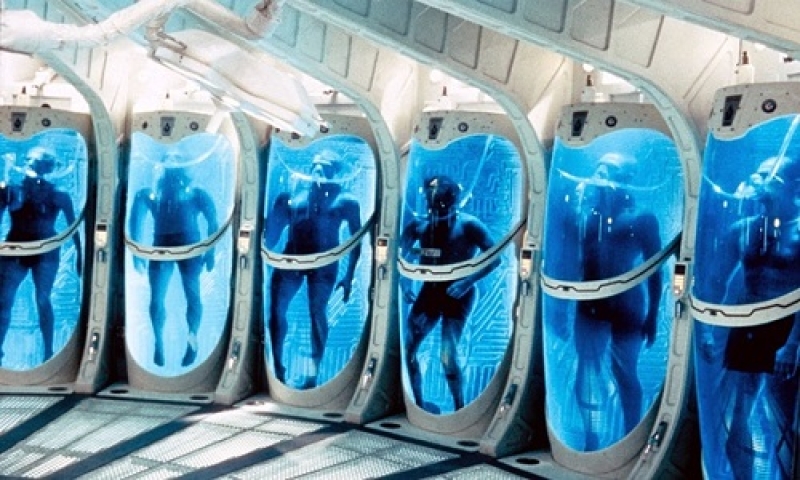
Image: Collected
Decades after sci-fi novels and mid-century futurists promised a world where freezing the deceased would serve as a bridge to technological immortality, the cryonics movement finds itself trapped in a deep freeze. Despite bold promises of medical resurrection, cryonics remains a fringe phenomenon, struggling for survival against scientific skepticism, institutional collapse, and cultural resistance.
When pioneer Robert Ettinger published The Prospect of Immortality in the 1960s, cryonicists envisioned a future where liquid nitrogen Dewars would replace cemetery plots. Yet, nearly sixty years after Dr. James Bedford became the first human cryonically preserved in 1967, global adoption remains strikingly low. Worldwide, only around 500 individuals are stored in cryonic suspension, with roughly 4,000 enrolled members—a negligible fraction of the millions who die annually.
As medical technology rapidly advances elsewhere, several critical factors explain why cryonics continues to fail to gain a foothold in the modern world:
1. The Pseudoscience Label and Biological Reality
The primary barrier facing cryonics is an overwhelming consensus of scientific skepticism. Mainstream cryobiologists and neuroscientists largely dismiss the practice, with the Society for Cryobiology long maintaining a distance from the field.
While modern cryonics uses vitrification—a process replacing blood with cryoprotective antifreeze agents to prevent ice formation—the human brain remains vastly too complex for current technology. Large tissues routinely develop microscopic fractures when cooled to −196°C. Critics note that preserving neural memory traces is fundamentally different from restoring consciousness, leaving no proof that vitrified brain tissue can ever be revived without catastrophic damage.
2. Organizational Failure and Economic Fragility
Cryonics requires uninterrupted maintenance over centuries—a timescale that commercial and non-profit organizations have historically failed to maintain.
Unlike eternal trusts promised by religious or state institutions, cryonics providers are small entities vulnerable to bankruptcy, legal challenges, and management mishaps. The industry’s early history was plagued by disasters, such as the collapse of the Cryonics Society of California in the 1970s, which resulted in nine preserved patients thawing and decomposing due to financial mismanagement. Today, the astronomical upfront costs—often exceeding $200,000 for whole-body preservation—make it an expensive gamble on an organization's ability to survive political, economic, and environmental shifts over hundreds of years.
3. Destruction of Cultural and Bereavement Rituals
In a seminal 2010 study on cryonics and American funeral culture, sociologist Oliver Krüger argued that cryonics fails because it fundamentally disrupts human mourning practices.
Traditional mortuary traditions rely on closure, local places of remembrance, and viewing the intact body. Cryonics strips families of these rituals, locking patients in industrial workshop Dewars located miles away from loved ones. Advanced practices like "neuropreservation"—where only the patient’s head is severed and frozen—frequently outrage grieving family members and spark intense legal battles. By declaring death "suspended" rather than final, cryonics deprives surviving relatives of definitive psychological closure.
4. The Existential Isolation of the "Möbius Body"
Beyond the biological and financial hurdles lies a profound philosophical dilemma. Cryonics operates under a hyper-individualistic assumption that biological survival is identical to living.
However, waking up hundreds of years in the future means reanimating into an alien world where a patient's family, culture, friends, and historical context have vanished. Trapped in what media theorists call a "Möbius body"—suspended between life and death, inside and outside of time—the cryonaut faces total social isolation.
For most, the prospect of an unanchored existence in an unfamiliar future is far less appealing than finding peace within the collective memory of their communities. Until cryonics can offer scientific proof rather than speculative optimism, it appears destined to remain an ambitious, costly artifact of techno-utopian ambition.