

- City govt essential for planned development of Chattogram: CCC administrator |
- Asian Stocks Slump After US Tech Rout Amid AI Jitters |
- Free Concert Featuring James and Seven Bands Set for Manik Mia Avenue |
- Garment factories reopen as workers return to work in Savar-Ashulia |
- Trump confirms new US strikes on Iran’s Qeshm island |
The Loneliest Light in the Marvel Universe: Silver Surfer and the Weight of the Stars
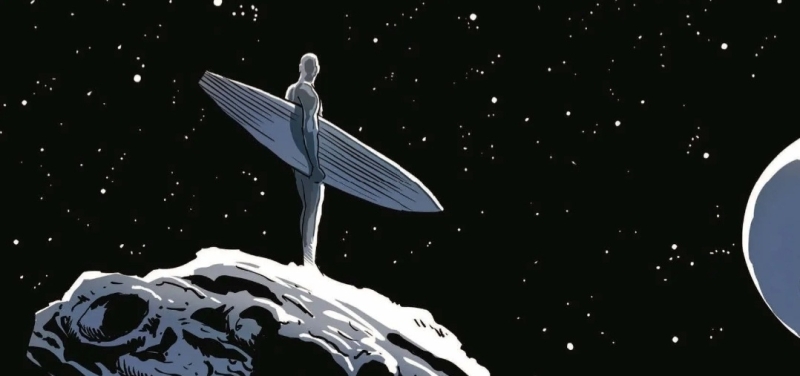
Image: Collected from Silver Surfer (Vol. 7) #11 (released in June 2015), written by Dan Slott and illustrated by artist Mike Allred.
Few fictional characters embody loneliness as completely as Marvel’s Silver Surfer. He can cross galaxies in seconds, command the Power Cosmic, and witness the birth and death of worlds—yet he remains a man exiled from home, love, and even his own humanity.
A Tragedy Drawn In Silver
The Silver Surfer first appeared in 1966’s Fantastic Four #48, created by Stan Lee and Jack Kirby during the landmark “Galactus Trilogy.” He was once Norrin Radd, a young astronomer from the utopian planet Zenn-La, who offered himself to Galactus—the devourer of worlds—to spare his home and beloved Shalla-Bal.
Galactus transformed him into a silver-skinned cosmic being, modeled on an adolescent fantasy drawn from Norrin’s memories. That transformation is the heart of his tragedy: Norrin saved everyone he loved, but lost the ability to stand beside them. His reward for compassion was an eternity of service, guiding Galactus to planets to consume.
Why The Character Is One Of Fiction’s Loneliest Figure
The Surfer’s loneliness is not merely physical isolation. It is moral loneliness: he becomes complicit in the destruction of innocent civilizations, then must live with the memory of every world he helped doom.
The character is separated from Zenn-La and Shalla-Bal, often by Galactus’s barrier or cosmic circumstance.
The Surfer possesses near-godlike power, but frequently cannot repair the emotional damage caused by the past.
The Surfer is too alien for humanity and too haunted for godhood, making every world feel like a temporary stop rather than a home.
The signature posture is a whole another different topic to discuss, alone on a board, riding through black space, this posture turns cosmic freedom into an image of exile.
That contrast makes the character more poignant than many superheroes. Superman represents hope; Batman represents trauma; the Silver Surfer represents remorse traveling at the speed of light.
Norrin Radd: the original Surfer
The mainstream Silver Surfer is Norrin Radd, the “Sentinel of the Spaceways.” After the Fantastic Four helped him rebel against Galactus, he was exiled to Earth, where his compassion for humans often put him at odds with the very people he tried to protect.
His greatest stories emphasize that he is not defined by power, but by conscience. In Silver Surfer: Requiem, he faces his approaching death with quiet dignity; in Silver Surfer: Black, Donny Cates and Tradd Moore send him into the primordial darkness of Knull, stripping him down to a nearly mythic figure of endurance.
The Darker Surfer
One striking iteration is the black-clad Silver Surfer of Annihilation: Scourge and the late-2010s Avengers storyline. After returning from the past, he remained in a black, cosmos-like form rather than his familiar silver appearance.
This version intensifies the character’s gothic loneliness. He is no longer merely a shining herald; he looks like the void he has spent his life crossing. In Silver Surfer: Black, he is trapped billions of years in the past and forced to battle Knull, the symbiote god, in a story that turns his cosmic sorrow into body horror and myth.
The Joyful Surfer: Dan Slott and Dawn Greenwood
Not every version of the Surfer is bleak. In 2014, writer Dan Slott and artists Mike and Laura Allred reinvented him in a brighter, more whimsical series. This Norrin Radd travels with Dawn Greenwood, an ordinary young woman from Anchor Bay, Massachusetts, whose curiosity and warmth reconnect him with wonder.
Dawn does not erase his guilt; she gives him a reason to face it. Their partnership reframes the Surfer’s journey as one of healing: he learns that saving the universe means little if he cannot learn to live in it.
Shalla-Bal: The Female Silver Surfer
The most important female version of the character is Shalla-Bal. In Marvel’s main continuity, she first appeared in 1968’s Silver Surfer #1 as Norrin Radd’s beloved and the Empress of Zenn-La.
But in the alternate-reality series Earth X, Shalla-Bal becomes a Silver Surfer herself, serving Galactus alongside Norrin in a struggle against the Celestials. Her version proves that the Surfer’s tragedy is not tied to one gender: anyone who accepts Galactus’s bargain inherits the same burden of survival, service, and sacrifice.
Shalla-Bal gained wider recognition when Julia Garner portrayed her as the Silver Surfer in the Marvel Cinematic Universe film The Fantastic Four: First Steps. That adaptation drew directly from the idea that Shalla-Bal, long known as Norrin’s lost love, could also carry the mantle.
Why The Surfer Endures
The Silver Surfer endures because his loneliness feels cosmic but deeply human. He is a person who made an impossible choice, gained impossible power, and discovered that neither can restore what was lost.
Whether he is Norrin Radd riding alone through the stars or Shalla-Bal bearing the same silver burden, the character asks a haunting question: what remains of a savior after everyone they saved has moved on? The answer, for the Silver Surfer, is a board, a universe of grief, and a heart that still chooses compassion.