

- City govt essential for planned development of Chattogram: CCC administrator |
- Asian Stocks Slump After US Tech Rout Amid AI Jitters |
- Free Concert Featuring James and Seven Bands Set for Manik Mia Avenue |
- Garment factories reopen as workers return to work in Savar-Ashulia |
- Trump confirms new US strikes on Iran’s Qeshm island |
Five Years of Spice: How Dune: Part One Made Epic Sci-Feeling Personal Again
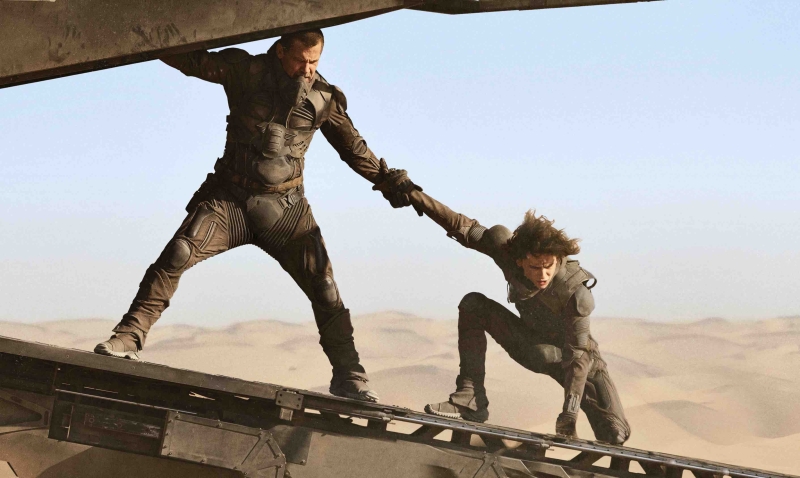
Image: Collected
Five years ago, Denis Villeneuve’s Dune: Part One arrived in theaters and on HBO Max, proving that a dense, strange, and famously “unadaptable” science-fiction novel could still become a global cinematic event. Released on October 22, 2021, the film did more than launch a franchise—it restored ambition, scale, and seriousness to blockbuster science fiction.
A Risky Return to Arrakis
Frank Herbert’s 1965 novel Dune had long carried a reputation as one of science fiction’s most difficult adaptations: vast in scope, political in nature, ecological in its concerns, and resistant to simple hero narratives. Villeneuve’s solution was not to compress the entire book into one film, but to split it into two parts, allowing room for Arrakis, the Fremen, the Bene Gesserit, and Paul Atreides’ political awakening to breathe.
That decision shaped the film’s identity. Dune: Part One is less a conventional action blockbuster than a slow, immersive initiation into a world—its sandstorms, spice economies, religious prophecies, and imperial rivalries. Its deliberate pace was sometimes criticized as incomplete, but it also gave the film a rare sense of scale and patience.
The Pandemic Blockbuster That Endured
The film’s release was itself a gamble. Delayed multiple times by the COVID-19 pandemic, Dune: Part One finally opened simultaneously in theaters and on HBO Max under Warner Bros.’ day-and-date release strategy—a decision Villeneuve publicly opposed.
Yet audiences showed up. The film earned about $411 million worldwide, becoming 2021’s tenth-highest-grossing film and one of its most-streamed titles. More importantly, it demonstrated that audiences would still embrace a challenging, visually ambitious science-fiction epic when it was made with conviction.
It's Importance In This Day & Age
At five years’ distance, Dune: Part One feels less like merely the first chapter of a franchise and more like a turning point for modern sci-fi cinema. It showed that blockbuster filmmaking could be contemplative without being empty, spectacular without being noisy, and faithful to difficult source material without surrendering cinematic personality.
Its legacy is visible in the confidence of its sequel and the continued appetite for large-scale, serious science fiction. Villeneuve’s Arrakis gave the 2020s a blockbuster that asked audiences not simply to watch a hero win, but to enter a complicated universe of ecology, empire, faith, and destiny.
The Fear Is the Mind-Killer
The film’s most enduring idea remains its simplest: fear is not something to deny, but something to face. Five years on, Dune: Part One endures because it trusted viewers to sit with uncertainty, mystery, and moral ambiguity. In an era of franchise fatigue, it reminded Hollywood that the boldest spectacle can still begin with a question rather than an explosion.