

- Titas Gas suffers Tk5,140cr loss from unbilled gas in two years |
- Arson Attempt Foiled as Staff Quench Fire on Mirpur Bus |
- Personalized mRNA Melanoma Vaccine Intismeran Hits Major Milestone, Cutting Recurrence Risk by 42% in Landmark Phase 3 Trial |
- City govt essential for planned development of Chattogram: CCC administrator |
- Asian Stocks Slump After US Tech Rout Amid AI Jitters |
Tesla Roadster Goes Airborne: SpaceX Thrusters, Upside-Down Driving & Sub-1-Second Acceleration
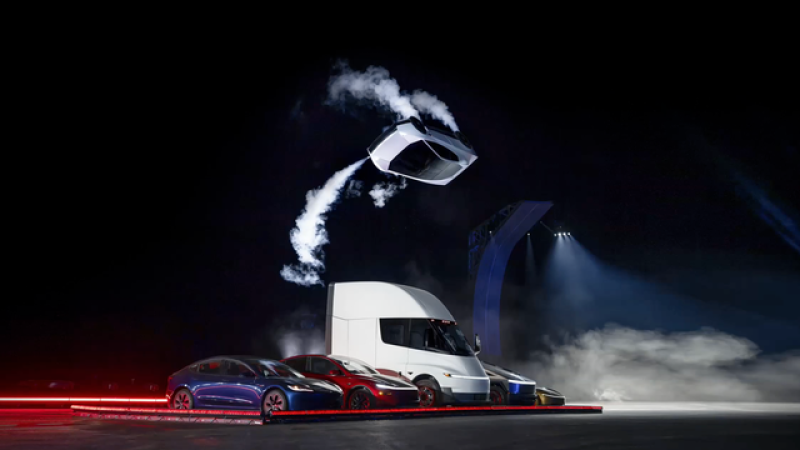
Image: Collected
At a dramatic nighttime reveal held at SpaceX’s rocket test site in McGregor, Texas, the long-delayed next-generation Roadster didn’t simply roll out from under a cover—it launched into the air.
Using a combination of high-powered underbody suction fans (capable of generating up to 2 Gs of downforce) and SpaceX-derived cold-gas thrusters, a prototype drove upside-down up a towering inverted ramp, then blasted off into a mid-air barrel roll before settling back to Earth in a cloud of vapor. Moments later it leapt clean over Tesla’s entire current lineup—including a Semi—executing what engineers called a “kickflip.”
The thrusters, fed by roughly 600 liters of compressed air stored in carbon-overwrapped pressure vessels, deliver more than 80 kN of force. That same system helped the Roadster smash the 0–60 mph barrier in a claimed 0.81 seconds during live runs—beating Musk’s long-standing “under one second” pledge.
Tesla is offering the car in three configurations:
● Performance (road-ready, two seats, suction system)
● Thrust (race-ready, rear thrusters, sub-0.9-second 0–60)
● Rocket (invite-only, single-seat, full perimeter thrusters for low-altitude flight and rotation—0–60 under 0.59 seconds and not street-legal)
All versions are said to deliver more than 300 miles of range and top speeds exceeding 230 mph. Production is targeted for 2028.
Nine years after the original concept stunned the world, the new Roadster has arrived—not just as the fastest production car Tesla has ever promised, but as the first one that can literally take flight.