

- City govt essential for planned development of Chattogram: CCC administrator |
- Asian Stocks Slump After US Tech Rout Amid AI Jitters |
- Free Concert Featuring James and Seven Bands Set for Manik Mia Avenue |
- Garment factories reopen as workers return to work in Savar-Ashulia |
- Trump confirms new US strikes on Iran’s Qeshm island |
Anthropic’s Claude Helps Reveal First 3D Structure of a Phage-Built Vault Particle
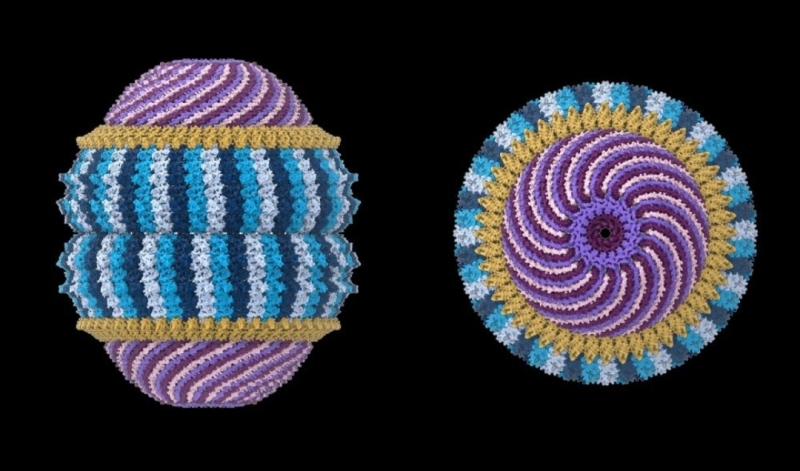
Image: Collected
Anthropic says its AI model, Claude, helped its biology team determine the first three-dimensional structure of a vault particle from prokaryotic life — a nanoscale protein shell assembled from a bacteriophage protein. The finding offers a new look at a family of mysterious cellular structures first discovered in mammalian cells 40 years ago.
A 96-protein shell
The particle is built from 96 copies of a single phage protein, named L05, arranged as 48 copies in each half of the shell. Anthropic says the structure weighs about 9.5 megadaltons and measures roughly 54 nanometers long by 45 nanometers wide.
Unlike mammalian vaults, which contain 78 copies of their main protein, the phage-derived vault is shorter and wider, with about 25% more internal volume. Cryo-electron microscopy resolved the structure at a nominal resolution of 3.2 angstroms.
How Claude helped
Anthropic said Claude searched a database of roughly 15 billion predicted proteins to identify vault-protein relatives across bacterial, archaeal, and phage genomes. It then helped design DNA constructs, optimize purification, and interpret experimental results.
The company said Claude-assisted optimization reduced a purification step that normally takes about three days to roughly 90 minutes, while the first structural model was completed in about 34 hours.
The importance of this endeavour
Vaults were discovered in 1986, but their biological function has remained unclear. The new structure confirms that vault-like particles can form in prokaryotic systems, not only in eukaryotic cells, and provides a detailed template for studying how these enormous shells assemble.
Anthropic said it has submitted a preprint to bioRxiv, meaning the results have not yet undergone formal peer review. The team also noted that the particles were assembled in laboratory E. coli, and it remains unknown whether the same structures form naturally inside the phages or bacteria from which the proteins originate.