

- City govt essential for planned development of Chattogram: CCC administrator |
- Asian Stocks Slump After US Tech Rout Amid AI Jitters |
- Free Concert Featuring James and Seven Bands Set for Manik Mia Avenue |
- Garment factories reopen as workers return to work in Savar-Ashulia |
- Trump confirms new US strikes on Iran’s Qeshm island |
From Hazaribagh to Savar: A $10 Billion Leather Dream, Built on an Incomplete Foundation
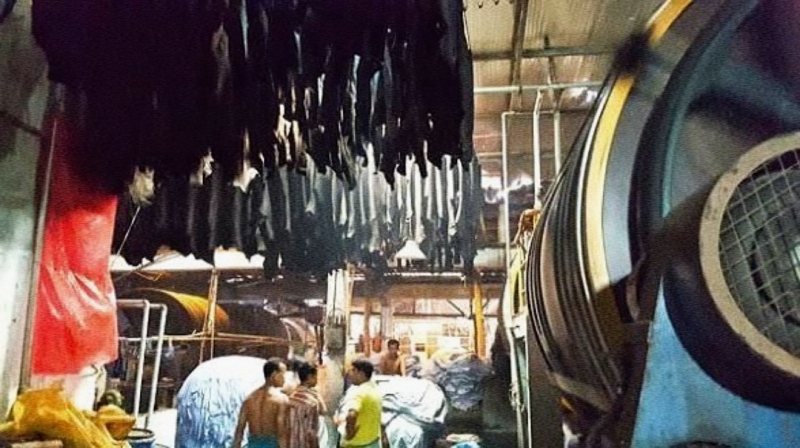
Image: Collected
Bangladesh’s leather sector has long been presented as a future export powerhouse. Successive governments have promised to move tanneries out of Hazaribagh, build modern treatment infrastructure at Savar, raise environmental standards, and turn leather and footwear into a multi-billion-dollar industry. Yet, as of November 2026, the central promise of that transition—a fully functional and legally compliant Central Effluent Treatment Plant, or CETP—remains unfulfilled. The result is a widening gap between ambitious policy announcements and the basic infrastructure needed to make them credible.
A relocation delayed for decades
The plan to relocate tanneries from Hazaribagh to the Savar Tannery Industrial Estate began in 2003. It was intended to end decades of pollution in Dhaka’s waterways and give the industry a planned, compliant home. While the physical relocation of over 150 tanneries was finally enforced and executed in April 2017 following a strict High Court order, the infrastructure serving them remains fundamentally flawed.
The CETP was meant to be the foundation of the new estate. Its completion deadline was changed eight times before June 2018 was fixed as the target date. While all four modules of the CETP were eventually constructed, they have never functioned at full or effective capacity. As of November 2026, the facility remains structurally mismanaged and unable to properly treat the massive volume of toxic waste generated daily by the active tanneries, preventing a true test run of fully compliant operations.
The delay in operational capability has practical consequences. Over 150 factories are operating at the Savar site, but they are trapped in a system that cannot safely process their effluent. Without a reliable, fully optimized treatment system in place, the estate cannot function as the compliant industrial hub it was designed to become.
Ambition versus delivery
The contrast between stated goals and on-the-ground delivery is stark. In 2026, the government announced an integrated reform plan for the leather sector, including a target of $10 billion in leather exports. It also pledged to upgrade the existing CETP, construct a new world-class treatment plant, require capable tanneries to install individual effluent treatment plants, and improve compliance and traceability across the value chain.
These are significant ambitions. But many of them remain at the announcement or planning stage. The new CETP is still being planned, while the existing facility must first be repaired and remediated. The government has also said it is preparing a roadmap for the leather and footwear industry, with stakeholder feedback to be sought after a draft is published.
Meanwhile, the proposed Tannery Solid Waste Management Policy—intended to turn waste into usable products and reduce environmental pressure—is still being drafted. In other words, the sector has no shortage of visions, targets, committees, or policy drafts. What it lacks is a completed, independently verifiable system that proves wastewater is being treated properly and that tanneries can meet international buyer requirements.
The environmental price
The most serious cost of delay is environmental. The CETP was supposed to prevent untreated tannery effluent from entering the Dhaleshwari River after the relocation from Hazaribagh. Instead, incomplete operational optimization and weak management performance have kept pollution concerns alive. Industry representatives have said the Savar CETP has yet to become safely operational, resulting in untreated wastewater frequently overflowing into the river.
The issue is not merely technical. A parliamentary watchdog reportedly recommended shutting down the tannery estate, but implementation of that recommendation was delayed despite alignment among environment ministry officials. That raises a broader governance question: when environmental risks are known and recommendations exist, why does enforcement remain slow?
A balanced article should not claim that every tannery is equally responsible or that pollution can be attributed to one actor alone. But it is fair to say that the state’s central environmental safeguard—the CETP—has failed to deliver the protection that justified the relocation in the first place.
Export potential at risk
The delay also carries an economic cost. Global buyers increasingly demand environmental compliance, traceability, and certification before sourcing leather products. The Leather Working Group certification, effluent management, and supply-chain documentation are no longer optional advantages; they are becoming market-access requirements.
Bangladesh’s leather industry cannot move confidently into higher-value finished leather and footwear if its core production hub is associated with incomplete wastewater treatment. Even tanneries that invest in better processes may face reputational risk because buyers assess the compliance of the wider production ecosystem.
This is why the CETP is not simply an environmental project. It is an export-competitiveness project. Without it, the government’s $10 billion export target risks becoming another headline detached from operational reality.
Public money and accountability
Public funds have been spent on a project that has repeatedly missed deadlines and failed to deliver full service. Reporting has described the Savar CETP as a “colossal failure” and raised concerns about misuse of public money. Such criticism should be examined carefully and factually, but it points to a legitimate need for stronger procurement, oversight, and operational accountability.
Experts have suggested keeping the CETP under public ownership while handing daily operations to an independent professional operator selected through transparent procurement. That approach could address a key weakness: a treatment plant cannot succeed if it is poorly operated, poorly maintained, or managed without technical independence.
A shared failure
It would be inaccurate to place all responsibility on government alone. Tannery owners have also contributed to the stalemate through delayed individual investments, uneven compliance efforts, and resistance to the operational costs associated with sophisticated effluent treatment.
The government, however, holds the regulatory authority, public financing, and coordination role. It must set enforceable deadlines, monitor compliance, and ensure that public infrastructure actually works. Tannery owners, in turn, must meet their obligations on cleaner production and environmental standards. A credible solution requires both sides to be held accountable.
Political continuity, not one-party blame
The tannery sector’s problems span multiple political cycles. The relocation policy, Savar estate development, and original CETP project took shape during periods of Awami League-led governments. Those administrations therefore carry historical responsibility for the design, financing, procurement, and oversight of a project that has still not delivered.
The current government has announced a broader reform agenda: a new CETP, remediation of the existing plant, individual ETPs, a waste-management policy, skills development, and a $10 billion export ambition. Its challenge is different: it must convert a long list of intentions into measurable outcomes. New targets will not restore confidence unless procurement is transparent, deadlines are binding, and environmental performance is independently monitored.
The fairest framing is therefore not that one party alone caused the crisis. It is that the failure has become institutional: successive governments have inherited, announced, revised, and re-announced solutions without ensuring that the basic treatment infrastructure functions.
What must change
Bangladesh needs fewer broad promises and more verifiable delivery. The government should publish a binding implementation calendar for the new CETP, repair of the existing plant, individual ETPs, and full environmental upgrades, with quarterly public reporting.
It should also appoint an independent professional operator for the CETP, create a properly empowered Leather Development Authority to coordinate ministries and stakeholders, and link incentives or export facilitation to verified environmental compliance. The forthcoming tannery waste policy must include enforceable rules on waste segregation, processing, monitoring, and by-product value chains—not only aspirational language.
Most importantly, progress should be measured by outcomes: cubic metres of wastewater safely treated, number of compliant tanneries, river-quality indicators, certified factories, and export performance. Policy launches alone should no longer count as progress.
Bangladesh does not lack ambition in the leather sector. It lacks a system capable of turning ambition into functioning infrastructure. Until the Savar CETP works reliably, both the government’s export vision and the industry’s global credibility will remain promises deferred.
Now that the errors are corrected, do you need help drafting an executive summary of these fixes, or are you interested in analyzing the economic impact of the current $10 billion export roadmap?