

- Oil Shock Sends Asian Markets Lower as Middle East Conflict Threatens Global Shipping |
- Trump Links Iran War to US Midterms, Backs United Ireland |
- PM Tarique Rahman Seeks Public Cooperation to Tackle Nationwide Dengue Outbreak |
- Jatiyatabadi Mahila Dal Vows to Lead Fight Against Rape, Violence Against Women and Children |
- 'Honorable' Dropped: PM Starts Implementing Decision from His Own Office |
Sangshad Bhaban: The Architectural Soul of Bangladesh
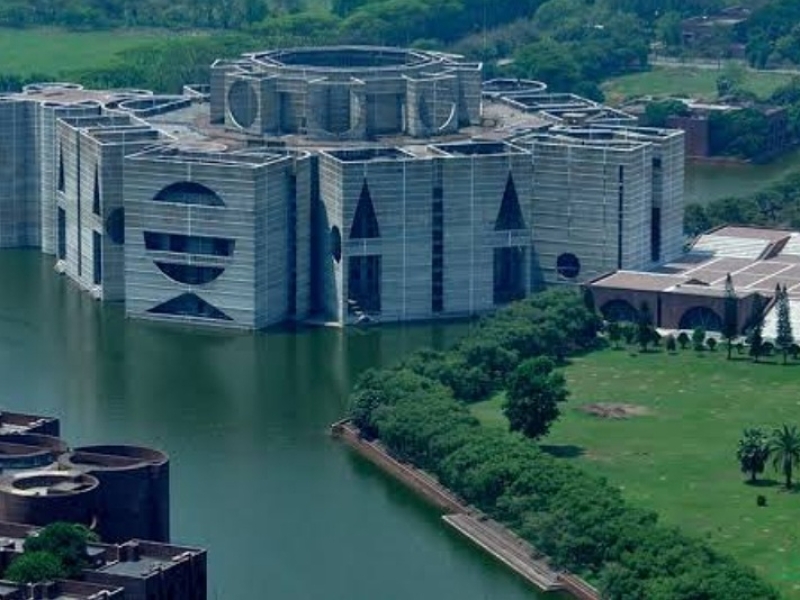
Image: Collected
Standing gracefully in the heart of Dhaka, the Jatiya Sangsad Bhaban is far more than the seat of Bangladesh's Parliament. It is a symbol of the nation's aspirations, resilience and identity, where architecture, history and culture come together to tell the story of an independent people.
Designed by renowned American architect Louis I. Kahn, the complex is widely regarded as one of the greatest works of modern architecture. Construction began in the 1960s and was completed in 1982, several years after Bangladesh gained independence. Today, the structure remains one of the country's most recognised landmarks and an enduring representation of democratic governance.
The building's striking geometric forms, circular openings and massive concrete walls create a timeless appearance. Surrounded by an expansive lake and lush greenery, the parliament complex offers a rare sense of calm amid the bustle of the capital. During sunrise and sunset, the reflections of the building on the surrounding water transform the landscape into a scene that resembles a work of art.
Yet the true significance of Sangshad Bhaban extends beyond its architectural beauty. It serves as the place where elected representatives debate national issues, formulate laws and shape the country's future. Every session held within its walls reflects the hopes, challenges and democratic journey of Bangladesh.
For many visitors, the complex represents more than a government institution. It is a destination where students study architecture, photographers capture its symmetry, artists find inspiration and citizens reconnect with a landmark that belongs to the nation. Its design continues to attract admiration from architects and scholars around the world, placing Bangladesh prominently on the global architectural map.
The surrounding gardens, open spaces and water bodies also highlight the importance of integrating nature with urban design. The harmony between concrete, light and landscape demonstrates how architecture can inspire both functionality and emotion.
Decades after its completion, Jatiya Sangsad Bhaban remains one of Bangladesh's greatest national treasures. It stands not only as the centre of parliamentary democracy but also as a lasting cultural icon that reflects the country's vision, creativity and enduring spirit.
In every angle of its design and every chapter of its history, Sangshad Bhaban continues to remind Bangladeshis that great architecture is not merely about buildings—it is about preserving a nation's identity for generations to come.