

- Actress Samira Khan Mahi Crowned 'Miss Universe Bangladesh 2026' |
- We must work together to resist anti-national conspiracies |
- Duchess of Edinburgh Princess Sophie to Arrive in Bangladesh Tomorrow |
- Bangladesh Bank Begins Selection Process for Young Entrepreneurs Today |
- Messi Wins Second MLS Golden Boot as Nashville Sets Points Record |
We must work together to resist anti-national conspiracies
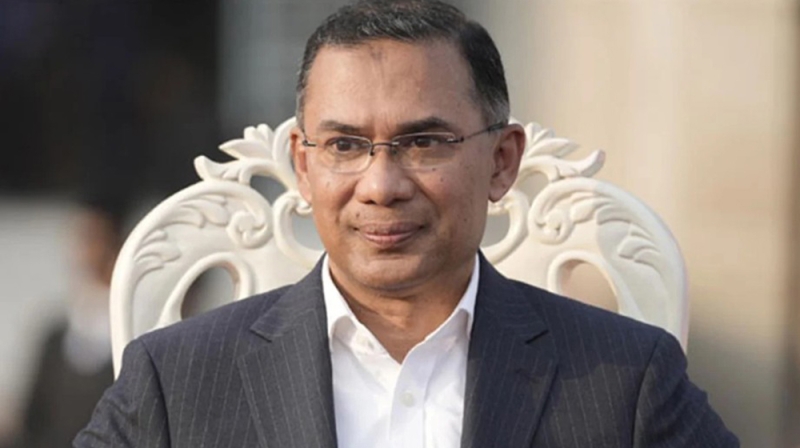
Photo: collected
Speaking as the chief guest at a rally held on Saturday ahead of a colorful procession marking the historic November 7 National Revolution and Solidarity Day, Prime Minister Tarique Rahman stated that we will respond to any domestic or foreign conspiracy—whether hatched within the country or from abroad—unitedly.
He emphasized that no one has ever been able to suppress the brave people of this country in the past, nor will anyone be able to suppress them in the future.
The Prime Minister made these remarks at a time when various plots against Bangladesh are becoming increasingly evident. Attempts to instigate sabotage by exploiting garment workers, fresh subversive activities by fugitive forces, and the main opposition party's movement demanding the immediate fall of the government appear to be tied together by a single thread.
The sole objective behind all these occurrences is to place an elected government in distress, imperil the nation's democracy, and dismantle the renaissance taking shape in Bangladesh under the leadership of the BNP.
The BNP government, led by Tarique Rahman, assumed the responsibility of running the country while standing amidst ruins. Immediately after taking charge, the government faced a series of global adversities.
Due to the war in Iran and rising tensions in the Middle East, the resulting worldwide fuel crisis and price hikes plunged Bangladesh into a severe economic ordeal. From that difficult position, the government has been making continuous efforts to meet the country's energy needs and keep economic activities functional. In the face of such a global crisis, everyone should have remained united regardless of party affiliation or ideology.
However, we observe with regret that certain forces are trying to create instability within the country under these circumstances. Some are attempting to fish in troubled waters. This is both unwarranted and unfortunate.
Behind the recent unrest and labor movements in the readymade garments (RMG) sector lie various underlying political and economic motives. Ministers, advisors, and political leaders of the government have pointed out that leaders of the ousted Awami League government, former ministers, MPs, and their associate organizations (such as the Chhatra League and Sramik League), along with members of the banned party, are fueling worker discontent to destabilize the country.
Several ministers have alleged that a specific group is using innocent workers to disrupt government operations ahead of the upcoming month of December. This sudden surge in labor unrest has raised many questions in the public mind: Is this movement truly aimed at securing workers' rights, or is it designed to extend a tactical advantage to the banned Awami League?
Accusations have surfaced that members of the banned Awami League and its affiliate organizations have joined garment workers on the ground to accelerate the demonstrations.
According to the Ministry of Home Affairs and intelligence reports, former Prime Minister Sheikh Hasina, who fled to India, along with beneficiary former ministers and MPs of her party, are the key instigators behind this instability.
In disguise, members of the banned Awami League, Sramik League, and Chhatra League have infiltrated the labor movements in Mirpur, Ashulia, and Gazipur, inciting violence, arson, and vandalism.
Against such anti-national conspiracies, it is vital for all political parties in the country to unite. Regrettably, the main opposition forces have launched anti-government demonstrations during this critical period.
An 11-party alliance led by Jamaat-e-Islami has been conducting long marches from Dhaka to various divisional headquarters, pushing a 7-point charter of demands that includes implementing the public mandate of the referendum, ensuring justice for the July genocide, and resolving shortages of electricity, oil, gas, and fertilizer.
This program kicked off on September 5 with a march toward Chattogram from Dhaka. The second phase took place on September 19 toward Rangpur, followed by the third long march on October 31 covering the Dhaka-Khulna-Kushtia route.
At multiple street rallies along the routes, leaders of the alliance—including opposition leader and Jamaat chief Dr. Shafiqur Rahman—delivered sharp anti-government speeches, explicitly raising threats of overthrowing the government and initiating a new revolution. Similar programs are scheduled for the Barishal, Rajshahi, Sylhet, and Mymensingh divisions in the coming days.
Questions are being raised as to what the opposition hopes to achieve through such aggressive programs just eight tight months into the government's tenure. Are they trying to send an immediate ultimatum or a different message to the administration?
Is such a harsh stance by opposition leaders warranted so early in the term, or has a situation genuinely arisen to justify programs like long marches? Street programs of this nature outside Parliament risk weakening democracy and placing it in jeopardy.
Does the opposition intend to undermine the democracy achieved through prolonged struggle?
Political analysts believe these opposition programs are giving fugitive political forces an opportunity to engineer chaos across the country.
Over the past few days, several incidents of sabotage, crude bomb explosions, and arson attacks on buses have been reported in various parts of the capital.
On Saturday, miscreants attempted to set fire to a passenger bus in the Mirpur-12 area of the capital. Police reported that bus staff and local residents managed to douse the flames promptly. In a single night, the capital witnessed at least eight crude bomb explosions and one bus arson incident.
On Friday evening (November 6) extending into late night, these explosions took place across Adabor, Shahbagh, Airport, Khilgaon, and the Kalshi area of Mirpur. On the same evening, miscreants set fire to a passenger bus belonging to Baishakhi Paribahan on Pragati Sarani in the Baridhara area.
A day prior, a crude bomb was detonated near a courier service covered van in front of the Krishi Market in Rayerbazar, causing a fire that injured the vehicle's driver.
These incidents represent a deliberate attempt to spread panic among citizens. Those behind these actions are clearly seeking to destroy the nation's peace and stability, drawing boldness from the political turmoil surrounding the opposition's street programs. If the unity forged through the July movement weakens, the path for the return of the fallen autocratic regime will become easier. Consequently, the nation will face instability again, the hard-earned democracy will be imperiled, and the vision of building a new, discrimination-free Bangladesh will be shattered.
To prevent such an outcome, everyone must unite against all forms of conspiracy and stand firm against sabotage. Prime Minister Tarique Rahman issued this very call for unity on Revolution and Solidarity Day.
Let us unite, save the nation, and protect democracy. Together, let us resist all anti-national conspiracies.