

- City govt essential for planned development of Chattogram: CCC administrator |
- Asian Stocks Slump After US Tech Rout Amid AI Jitters |
- Free Concert Featuring James and Seven Bands Set for Manik Mia Avenue |
- Garment factories reopen as workers return to work in Savar-Ashulia |
- Trump confirms new US strikes on Iran’s Qeshm island |
Drilling for the Ark: Turkey’s Durupınar Site Yields Organic Material
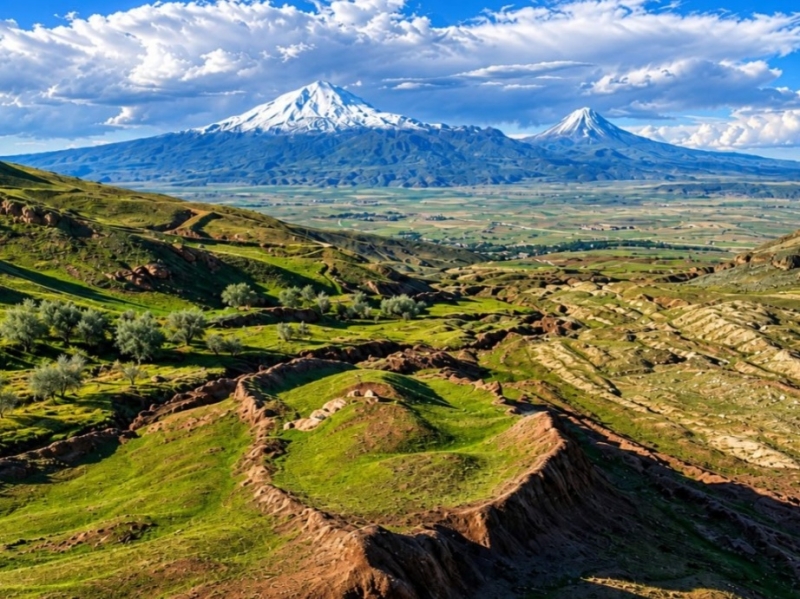
Image: Collected
An international research team has begun core drilling at Turkey’s controversial Durupınar Formation, recovering what organizers describe as organic material from deep underground and fueling fresh debate over whether the boat-shaped site could be linked to the biblical Noah’s Ark.
Largest permitted expedition yet
The 2026 field season, led by archaeologist Cenker Atila of Sivas Cumhuriyet University, ran for about 90 days with roughly 20 researchers from five countries. The group collected around 1,000 soil samples from some 150 locations and used ground-penetrating radar to map subsurface features across the 515-foot-long formation near Mount Ararat.
Andrew Jones, founder of U.S.-based Noah’s Ark Scans, said the team recovered “layers of rich organic material” and encountered underground cavities, including one filled with mud and water. In one borehole, drilling halted roughly 13–16 feet below the surface when the drill bit shattered against a hard layer. Jones said petrified or mineralized wood is “one possibility” the team wants tested.
Preliminary soil readings showed the formation’s interior contains about 40 percent more carbon than surrounding soil, according to coverage by Gadget Review. Radar scans also picked up subsurface anomalies with what researchers described as regular edges and apparent right-angle intersections, though their origin remains uncertain.
“Could be corridors or rooms”—or just geology?
Atila told Turkey’s IHA news agency that radar revealed voids that “could potentially be corridors or rooms.” But the findings are still preliminary, and no peer-reviewed paper has yet been published.
Skepticism remains strong. In a 1996 study, geologist Lorence Collins and explorer David Fasold concluded the Durupınar Formation was “a completely natural rock formation,” identifying it as an eroded fold in sedimentary rock. Most geologists continue to support that interpretation.
The expedition’s marketing director, Lauren Witzke—a former U.S. Senate candidate and self-described flat-earther—has made sweeping claims on social media, writing that “Darwinism will be dismantled” when the work is complete. Academic researchers on the project have been more cautious. Atila said lab results expected over the winter would be decisive: “If Noah’s Ark really exists, we can say that the place is the Durupınar Formation.”
What happens next
Laboratory analysis of soil and core samples is expected to continue through winter 2026–2027. The team plans to release a detailed report and conduct further fieldwork next year, pending funding and permissions.
For now, the Durupınar site remains one of archaeology’s most polarizing locations: a natural wonder to most geologists, and, to a determined group of researchers, the strongest candidate yet for the resting place of humanity’s most famous ship.