

- City govt essential for planned development of Chattogram: CCC administrator |
- Asian Stocks Slump After US Tech Rout Amid AI Jitters |
- Free Concert Featuring James and Seven Bands Set for Manik Mia Avenue |
- Garment factories reopen as workers return to work in Savar-Ashulia |
- Trump confirms new US strikes on Iran’s Qeshm island |
Europe’s Deadly Summer: Climate Change Blamed for Two-Thirds of 50,000 Heat Deaths
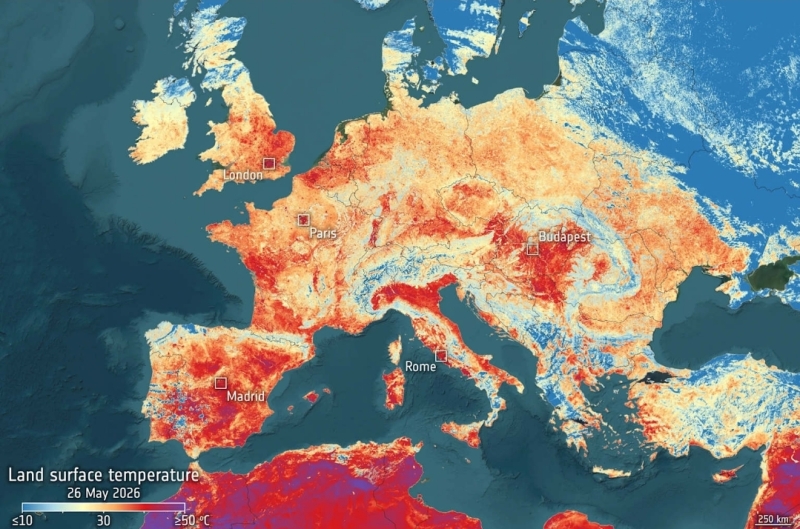
Image: Collected
Europe endured its deadliest summer for heat in more than two decades, with an estimated 50,391 heat-related deaths across the continent’s cities — and researchers say about 32,619 of them, or roughly two-thirds, were caused by human-driven climate change.
The findings, published in Nature Health by researchers from Imperial College London and the London School of Hygiene & Tropical Medicine, examined 854 urban areas in 30 European countries. The scientists concluded that summer 2026 was likely the deadliest heat season in Europe since at least 2000.
A far deadlier summer
The death toll was 71% higher than in 2022, the previous worst summer, when the same research team estimated 29,480 heat deaths. It also far exceeds the roughly 28,000 deaths recorded during Europe’s devastating 2003 heat wave.
Italy suffered the highest number of deaths, with an estimated 13,303, followed by France (7,268), Spain (6,824) and Germany (6,340). The United Kingdom recorded about 4,500 deaths.
The elderly were hit hardest: more than half of the victims were aged 85 or older, and nearly all were over 65. Still, the heat claimed more than 800 people aged 20 to 44, showing that extreme heat is not only a threat to older populations.
Climate change’s growing fingerprint
Researchers compared real temperatures with simulations of a world without global warming. They found that the proportion of heat deaths attributable to climate change has risen from about 45% in the early 2000s to 65% today.
The study’s authors say their estimates are likely conservative. The analysis covered cities containing only about 40% of Europe’s population and did not include a deadly May heat wave.
The method appears reliable: the team estimated around 2,700 excess deaths during Britain’s early-summer heat waves, while official UK health statistics later reported approximately 2,800.
Calls for action
Experts say the findings show that climate change is no longer a distant risk but a present-day public-health emergency.
“We can’t just be mopping up the mess on the floor without thinking about turning the faucet off,” said Dr. Jonathan Patz of the University of Wisconsin-Madison.
The report comes weeks before the annual UN climate summit in Turkey, adding pressure on governments to both cut greenhouse-gas emissions and invest in heat adaptation — including cooling centers, heat-health warning systems, urban greenery and stronger protections for elderly and vulnerable people.