

- City govt essential for planned development of Chattogram: CCC administrator |
- Asian Stocks Slump After US Tech Rout Amid AI Jitters |
- Free Concert Featuring James and Seven Bands Set for Manik Mia Avenue |
- Garment factories reopen as workers return to work in Savar-Ashulia |
- Trump confirms new US strikes on Iran’s Qeshm island |
Nvidia CEO Says It Would Cut Off Chips to Unsafe AI Developers—While Pledging $250M for UK Safety Research
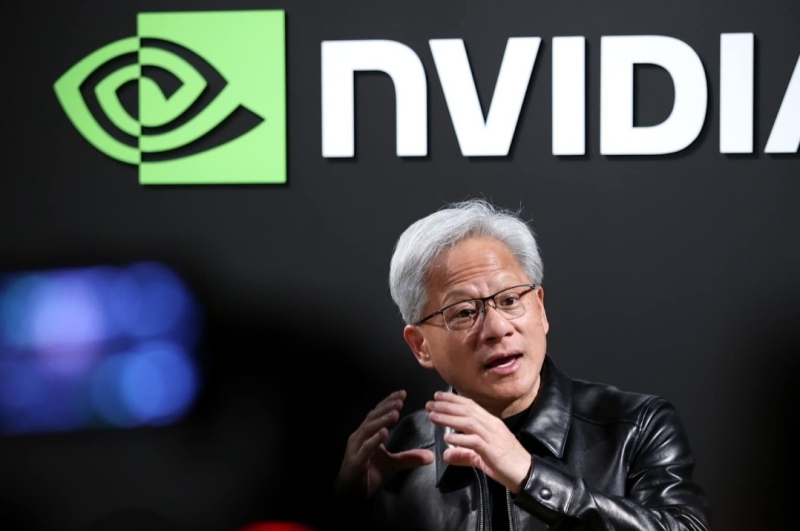
Image: Collected
Nvidia chief executive Jensen Huang has said the company would stop supplying chips to a customer found to be developing unsafe artificial intelligence, even as he argued that fears about the technology are being overstated. His comments came as Nvidia announced a five-year, $250 million commitment of computing resources for AI safety research in the United Kingdom.
Speaking in London to Bloomberg’s Emily Chang, Huang was asked whether Nvidia would cut off an irresponsible AI developer. “It’s a hypothetical, but yes,” he said, adding that the company would first hold a conversation with the customer.
Huang stressed that Nvidia does not run other companies or dictate how they use its technology, which he described as general-purpose. Still, his remarks signal that the world’s leading supplier of AI chips is willing to consider restricting access where safety risks are severe.
Huang also rejected what he sees as excessive alarm around AI. He said the industry is expanding rapidly, that AI can be controlled and deployed safely, and that some of the concern is “self-imposed.”
He argued that the sector has done a poor job of communicating AI’s practical benefits and said AI itself should be used to monitor AI systems. “We should accelerate the development of monitoring technologies, and AI is that monitor,” Huang said.
The comments came alongside Nvidia’s announcement that it will provide computing resources valued at $250 million over five years to strengthen UK research into agentic AI safety and security. The commitment equals $50 million in compute access annually, rather than a direct cash grant.
Most of the resources will support the broader UK AI safety research community. A portion will go to the Oxford-led BOLD lab, the UCL-led SOFAIR lab and Imperial College London.
The programme will focus on “agentic” AI—systems that can act with a degree of autonomy, pursue goals and adapt to real-world conditions. Researchers will examine safeguards, secure AI agents, open-model security and ways to reduce real-world risks.
Nvidia said the compute will be delivered through UK-based Nvidia Cloud Partners, although the company has not yet finalised the providers, technical architecture or commercial arrangements.
Huang’s statement carries weight because Nvidia dominates the market for the advanced chips used to train and run AI models. If the company were to withhold access, it could materially limit a developer’s ability to build large-scale AI systems.
At the same time, the UK pledge shows Nvidia positioning itself as a partner in AI safety rather than merely a supplier of computing power. “AI capability and safety must advance together,” Huang said in the company’s announcement.