

- Oil Shock Sends Asian Markets Lower as Middle East Conflict Threatens Global Shipping |
- Trump Links Iran War to US Midterms, Backs United Ireland |
- PM Tarique Rahman Seeks Public Cooperation to Tackle Nationwide Dengue Outbreak |
- Jatiyatabadi Mahila Dal Vows to Lead Fight Against Rape, Violence Against Women and Children |
- 'Honorable' Dropped: PM Starts Implementing Decision from His Own Office |
Parliament Passes NHRC and Enforced Disappearance Bills Following Opposition Walkout
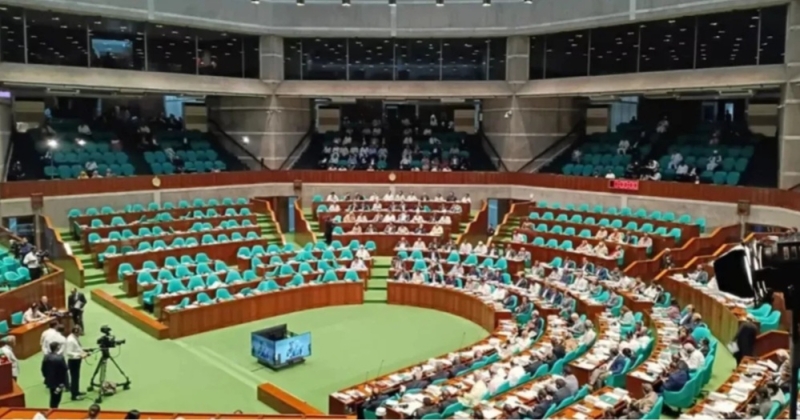
Image: Collected
SANGSAD BHABAN, DHAKA, Sept 6 — The Jatiya Sangsad passed three major legislative proposals on Sunday night, including the National Human Rights Commission Bill, 2026 and the Enforced Disappearance Prevention and Redress Bill, 2026, despite a walkout staged by opposition lawmakers. The third measure, the Transfer of Property (Amendment) Bill, 2026, was enacted while opposition members remained present in the chamber.
Law, Justice and Parliamentary Affairs Minister Md Asaduzzaman piloted the National Human Rights Commission Bill, 2026 and the Transfer of Property (Amendment) Bill, 2026, while Home Minister Salahuddin Ahmed moved the Enforced Disappearance Prevention and Redress Bill, 2026. All three proposals were passed individually through voice votes.
Prior to the passage of the two human rights bills, opposition parliamentarians exited the House in protest, covering their mouths with black cloth. They criticized the legislation for creating unequal standards in investigating rights violations, particularly concerning disciplined forces, and argued that the new proposals were weaker than ordinances previously issued by the interim government. Opposition Leader Shafiqur Rahman expressed strong reservations before the walkout, asserting that the bill fails to apply uniform legal principles across all citizens.
The newly enacted National Human Rights Commission Bill repeals the 2009 Act to establish a updated structure designed to strengthen commission independence. The body will comprise a chairman and four commissioners recommended by a ten-member selection committee headed by the Speaker of Parliament. It also outlines specific procedures regarding disciplined forces, allowing the commission to request reports from relevant security institutions when complaints arise and make recommendations based on their findings.
The Enforced Disappearance Prevention and Redress Bill formally criminalizes enforced disappearance as a cognizable, non-bailable, and non-compoundable offense. Punishment ranges from life imprisonment to the death penalty if a victim dies or remains missing for over five years, accompanied by fines reaching up to Tk 1 crore. The law designates investigation responsibilities to the police and requires both investigations and trials to conclude within a 120-day timeline.
Additionally, the Transfer of Property (Amendment) Bill modifies the Transfer of Property Act, 1882 to legally recognize lifetime usufruct rights. Under this provision, parents, grandparents, or spouses who transfer real estate as gifts to immediate family members can legally preserve their right to occupy and use the property for the remainder of their lives.