

- City govt essential for planned development of Chattogram: CCC administrator |
- Asian Stocks Slump After US Tech Rout Amid AI Jitters |
- Free Concert Featuring James and Seven Bands Set for Manik Mia Avenue |
- Garment factories reopen as workers return to work in Savar-Ashulia |
- Trump confirms new US strikes on Iran’s Qeshm island |
Lawmakers Demand Long-Term Master Plan, Transparent BRT Probe to Save Gazipur
Lawmakers Demand Long-Term Master Plan, Transparent BRT Probe to Save Gazipur
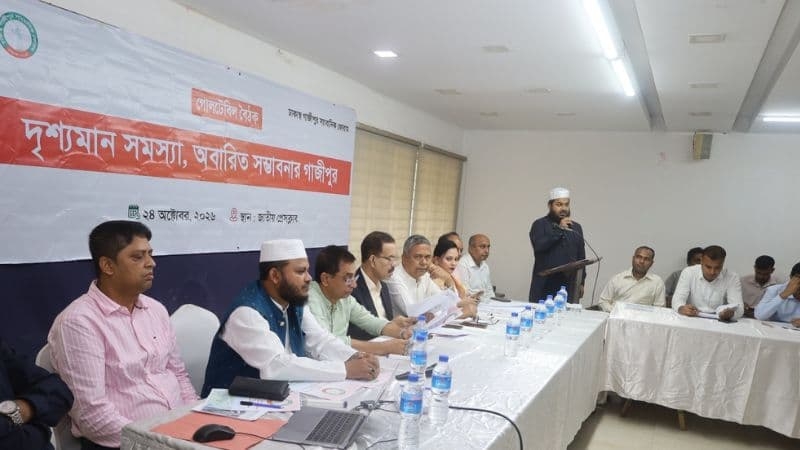
Image: Collected
Various members of parliament and prominent figures have stressed the urgent need for a long-term master plan to ease traffic congestion, protect the environment, and ensure structured urbanization in Gazipur. Speaking at a recent roundtable, they also called for a transparent reassessment of the Bus Rapid Transit (BRT) project's future, the extension of the elevated expressway and metro rail to Gazipur, and robust measures to restore discipline on the roads.
These remarks were made on Saturday morning (October 24) at the National Press Club in Dhaka, during a discussion titled "Gazipur: Visible Problems and Unlimited Potential," organized by the Gazipur Journalists Forum. Chaired by Forum President Faisal Alam and moderated by General Secretary Rashedul Haque, the event brought together key policymakers and local leaders, including Gazipur-5 MP AKM Fazlul Haque Milon, Gazipur-3 MP SM Rafiqul Islam Bachchu, Gazipur-1 MP Md. Mojibur Rahman, Gazipur-4 MP Salah Uddin Ayubi, reserved seat MP Selina Sultana Nishita, Deputy Commissioner Md. Nurul Karim Bhuiyan, and GMP Additional Commissioner Mohammad Taherul Haque Chauhan.
Presenting the keynote paper, the forum’s organizing secretary, Faisal Khan, highlighted how industrial waste and uncoordinated factory setups are degrading Gazipur's environment. He emphasized the need for strict factory regulations and proper waste management. The report also spotlighted pressing local challenges, including severe traffic jams, the proliferation of narcotics, juvenile delinquency, public waste dumping, robberies, waterlogging, unplanned industrialization, dysfunctional railway stations, forest encroachments, and the filling of agricultural lands.
The keynote further detailed criminal activities in infrastructure built for the BRT project, persistent waterlogging even during light rains, and acute shortages of housing and safe transport for workers in the Sreepur industrial zone. It recommended operationalizing the Satkhamair and Izzatpur railway stations in Sreepur with necessary train halts. Additionally, the report expressed grave concern over forest encroachment in Kaliakoir and the destruction of agricultural lands, canals, and wetlands under the guise of housing projects in Kaliganj.
Recommendations for the BRT Project
The keynote paper suggested reconsidering the cancellation of the BRT project and the demolition of existing structures, advising that future decisions be based on a transparent evaluation. Taking into account the 14-year suffering of Gazipur residents and the transit needs of commuters from 18 districts, the report emphasized creating a fast, affordable, and effective transit system. It recommended publicly clarifying the rationale behind the cancellation, conducting an impartial investigation into any irregularities, corruption, or planning failures, and publishing the findings. Since the BRT remains incomplete, the paper proposed alternative connectivity solutions, specifically extending the elevated expressway and metro rail from Dhaka to Gazipur.
Key Remarks from Lawmakers
During the session, Gazipur-5 MP AKM Fazlul Haque Milon noted, "People from every corner of Bangladesh live in Gazipur. A comprehensive master plan that accounts for this vast population is essential. The BRT project faced skepticism from its inception; while BRT systems work globally, local realities must be prioritized in densely populated areas like Gazipur." He added that active and accountable police intervention could curb the drug crisis.
Gazipur-3 MP SM Rafiqul Islam warned of the district's critical condition, stating, "Industrialization has proceeded without environmental safeguards. With people from all over the country residing here, we must plan for the next century, or this region risks becoming uninhabitable."
Gazipur-1 MP Md. Mojibur Rahman questioned whether the BRT project effectively resolved traffic congestion. He suggested that an elevated flyover from Uttara connecting Kaliganj, Mymensingh, and Joydevpur would have better facilitated traffic flow, criticizing the central road dividers for narrowing lanes. He advocated for AI-enabled traffic cameras and urged both law enforcement and parents to combat drug abuse.
Gazipur-4 MP Salah Uddin Ayubi demanded clarity on alternatives to the BRT project, proposed building a park in Joydevpur, and called for police reforms, reduced bus fares, and the extension of the elevated expressway. He also touched upon the prospective formation of the Kapasia Municipality within five years.
The event concluded with remarks from Senior Vice President Ataur Rahman, Office Secretary SM Noor Mohammad, Communications Secretary Sabbir Ahmed, Senior Member Manjur Bari, and Executive Member Saiful Islam Shuvo.