

- Arson Attempt Foiled as Staff Quench Fire on Mirpur Bus |
- Personalized mRNA Melanoma Vaccine Intismeran Hits Major Milestone, Cutting Recurrence Risk by 42% in Landmark Phase 3 Trial |
- City govt essential for planned development of Chattogram: CCC administrator |
- Asian Stocks Slump After US Tech Rout Amid AI Jitters |
- Free Concert Featuring James and Seven Bands Set for Manik Mia Avenue |
"Democracy and Human Rights Are Not Safe in Tarique Rahman's Hands: Nahid"
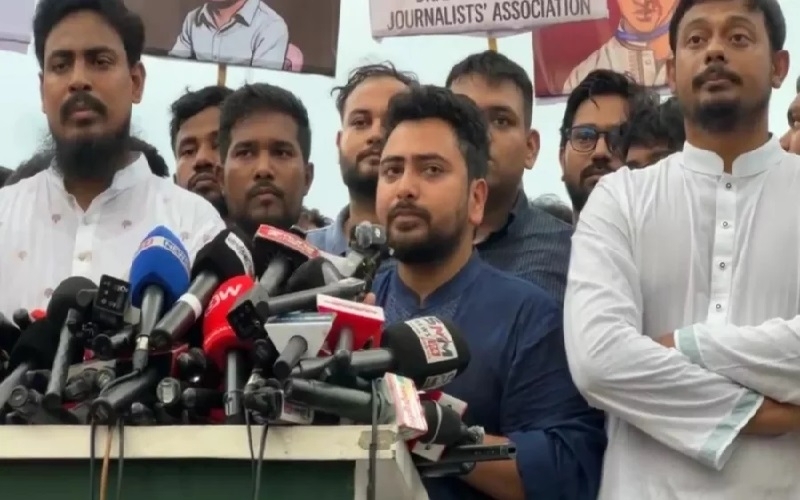
Image: Collected
Nahid Islam, Convener of the National Citizen Party (NCP) and Chief Opposition Whip in Parliament, has alleged that democracy and human rights are not safe under the leadership of Prime Minister and BNP Chairman Tarique Rahman. He also accused Tarique Rahman of emerging as a "new autocrat."
Nahid Islam made these remarks on Friday afternoon (September 18) during a human chain demonstration organized by the NCP in front of the Parliament building. The demonstration was organized to protest alleged government actions involving the passage of laws that violate human rights, suppression of opposition voices, and the deprivation of citizens' fundamental rights.
Nahid Islam said, "Democracy is not safe in Tarique Rahman's hands, nor are human rights safe. Tarique Rahman has emerged as a new autocrat." This statement reflects his political stance and allegations; reports did not mention an immediate official response from the government on the matter.
Nahid Islam demanded amendments to laws related to enforced disappearances and the National Human Rights Commission. He also called for changes to the Cyber Security Act, stating that freedom of expression must not be curtailed under the guise of legal reforms.
The NCP leader also questioned the government's role regarding allegations of missing persons. Citing the case of Miraj Sheikh, a fisherman from Bagerhat who went missing, Nahid noted that there has been no trace of him for five months. According to Nahid, when Miraj's family attempted to file a report at the police station, it was initially rejected; later, when a general diary (GD) was recorded, they were reportedly not allowed to mention the Coast Guard.
However, Home Minister Salahuddin Ahmed had previously stated that an independent investigation into Miraj Sheikh's disappearance found no evidence of political motive. He noted that instructions had been issued to investigate Miraj's case.
Nahid Islam also criticized the filing of cases under the Anti-Terrorism Act against Gazi Salahuddin Tanvir and Sifat, who are associated with the NCP.
He argued that offensive remarks by individuals should not be equated with terrorism, adding that people's right to freedom of expression is being suppressed in the name of the Anti-Terrorism Act.
The NCP had previously stated that organizational action was taken against Gazi Salahuddin Tanvir following allegations that he made offensive remarks about the Prime Minister.
On the other hand, a case under the Anti-Terrorism Act was filed against Sifat Abdullah of Gazipur over alleged derogatory remarks about the Prime Minister. On September 7, a Gazipur court rejected his bail application.
Nahid Islam demanded that if allegations of disappearances are brought against members or agencies of law enforcement, the investigation should not be conducted by the same force.
Furthermore, he expressed concern that families of missing persons might be discouraged from filing cases or complaints if provisions punishing false allegations exist.
The NCP convener also alleged that the Anti-Corruption Commission (ACC) is being weaponized against opposition political leaders, stating that if the ACC is used against him or his party's leaders, they will confront it.
Nahid also criticized the non-formation of a police reform commission, alleging that the police force is being prepared to suppress opposition voices.
He demanded the establishment of an independent mechanism to investigate human rights violation allegations and to safeguard democratic and constitutional rights.