

- Titas Gas suffers Tk5,140cr loss from unbilled gas in two years |
- Arson Attempt Foiled as Staff Quench Fire on Mirpur Bus |
- Personalized mRNA Melanoma Vaccine Intismeran Hits Major Milestone, Cutting Recurrence Risk by 42% in Landmark Phase 3 Trial |
- City govt essential for planned development of Chattogram: CCC administrator |
- Asian Stocks Slump After US Tech Rout Amid AI Jitters |
Titas Gas suffers Tk5,140cr loss from unbilled gas in two years
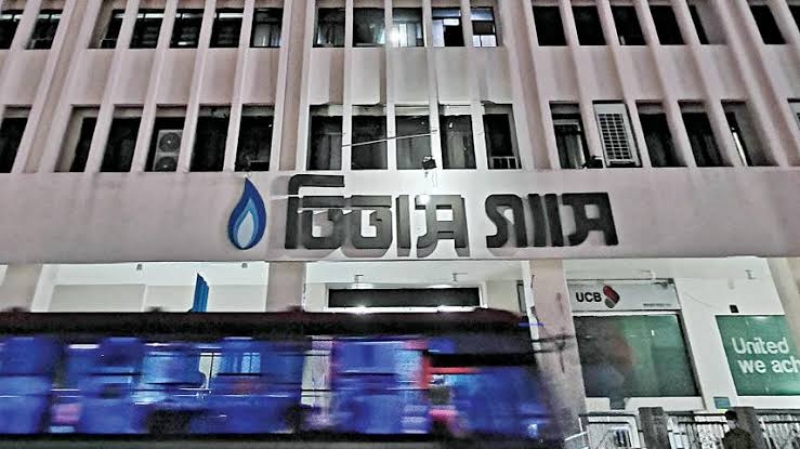
Image- Collected
System losses at Titas Gas Transmission and Distribution Company Limited have climbed nearly fivefold in four years, reaching almost 10% in FY26 and causing substantial financial damage to the state-owned utility.
According to the company's audited financial report, Titas Gas recorded system losses worth Tk2,719 crore in FY26 and Tk2,422 crore in FY25. The combined loss over the two fiscal years amounted to Tk5,140 crore.
The amount represents more than one-third of the Tk14,600 crore Bangladesh spent on LNG import subsidies in FY26, according to Petrobangla data.
System loss refers to the difference between the volume of gas received by Titas from its own pipelines and the Gas Transmission Company Limited (GTCL), and the amount ultimately billed to consumers.
System losses exceed permitted limits
Titas maintained system losses at around 2% between FY20 and FY22, within the government's allowable limit. However, the rate increased to 5.28% in FY23, 7.67% in FY24, 9.47% in FY25 and 9.96% in FY26.
Government regulations allow Titas a maximum system loss of 2%. The company must bear the cost of any losses exceeding that limit.
In its audited report, Titas said the 7.96 percentage-point excess loss in FY26 forced it to absorb substantial gas procurement costs without earning revenue from the unbilled volume, severely affecting profitability.
The company consequently posted a net loss of Tk595 crore in FY26, with earnings per share (EPS) falling to negative Tk6.02. This followed a net loss of Tk772 crore in FY25. Its cumulative net losses over FY23–FY26 have reached Tk2,275 crore.
Despite the continued losses, Titas recommended a 2% cash dividend for FY26, funded through retained earnings and non-operating income, mainly interest earned from fixed deposit receipts (FDRs).
Auditor ACNABIN reported that Titas received 15,428 million cubic feet (mmcf) of gas in FY26 but billed customers for only 13,892 mmcf. The unbilled volume of 1,536 mmcf was valued at Tk2,719 crore. In FY25, the unbilled volume stood at 1,436 mmcf, worth Tk2,421.76 crore.
Illegal connections and ageing pipelines
Titas officials have attributed the rising losses to illegal connections, deteriorating pipelines, accidental damage during municipal excavation, inaccurate metering and arbitrary billing for unmetered domestic consumers.
Abu Sadat Md Sayem, deputy general manager of Titas Gas's Vigilance Division, identified these issues as the main causes of the losses. He said several initiatives were under way, but a permanent solution remained out of reach.
Sayem noted that much of the distribution network was installed during the 1960s and 1970s, exceeding the standard 30-year operational lifespan of pipelines. Maintaining a secure, leak-free network has therefore become increasingly difficult.
Excavation work by municipal agencies also damages pipelines, sometimes causing continuous leaks that go undetected. However, Sayem identified unauthorised connections as the biggest contributor to gas losses.
He said illegal lines are frequently connected to residential buildings and industrial areas. Although enforcement teams disconnect them, they are often reinstalled shortly afterwards.
Differences in measurement between GTCL's 27 high-precision primary meters and nearly 1,500 secondary meters used by Titas across its network further contribute to the problem.
Domestic billing rules add to losses
The billing system for unmetered residential consumers is another source of financial pressure. Under Bangladesh Energy Regulatory Commission (BERC) rules introduced in 2022, monthly gas consumption is calculated at 55 cubic metres for single-burner stoves and 60 cubic metres for double-burner stoves.
However, actual consumption can be considerably higher. In densely populated urban areas, several subtenant families may share one stove, while some households operate burners continuously to boil water or prepare meals for commercial workers.
In a 2023 proposal to BERC, Titas requested higher assumed monthly consumption limits of 76.65 cubic metres for single-burner and 88.88 cubic metres for double-burner connections until prepaid meters could be introduced nationwide. The proposal has not yet been implemented.
Turnover tax adds financial pressure
The existing tax structure has further weakened the company's financial position, according to Md Nur Hossain Khan, general manager of Titas Gas's Finance Division.
He said declining revenue from core operations had forced the company to depend more heavily on non-operating income, such as interest from fixed deposits, to sustain operations and pay dividends.
Under the Finance Act 2026, Titas faces a corporate income tax rate of 20%. However, Section 163 requires the payment of minimum turnover tax when the calculated corporate tax liability falls below the prescribed threshold.
As Titas recorded a pre-tax net loss in FY26, it had no standard corporate income tax liability. Nevertheless, it was required to pay turnover tax based on its total sales, adding a significant tax expense despite its operating deficit.