

- Arson Attempt Foiled as Staff Quench Fire on Mirpur Bus |
- Personalized mRNA Melanoma Vaccine Intismeran Hits Major Milestone, Cutting Recurrence Risk by 42% in Landmark Phase 3 Trial |
- City govt essential for planned development of Chattogram: CCC administrator |
- Asian Stocks Slump After US Tech Rout Amid AI Jitters |
- Free Concert Featuring James and Seven Bands Set for Manik Mia Avenue |
Govt to support technology sector, says Dr Titumir
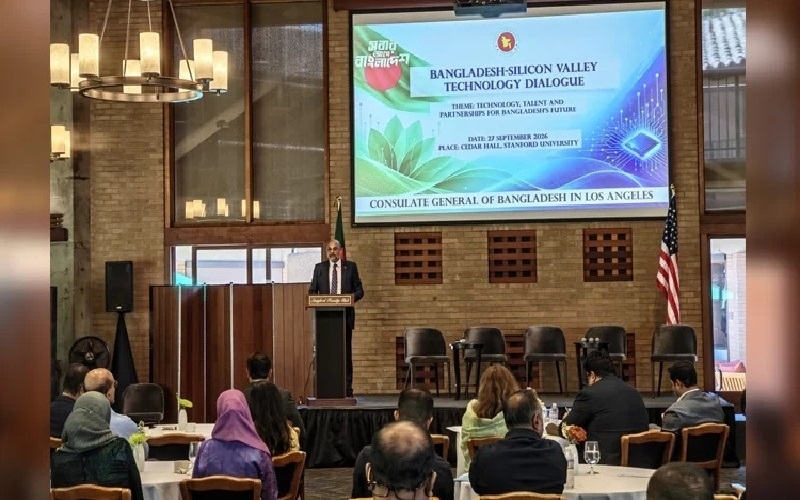
Image- Collected
The government has taken initiatives to support technology-based companies to expand technology-driven employment and make technology services more accessible to citizens, said Prime Minister’s Adviser on Economic and Planning Affairs Dr Rashed Al Mahmud Titumir.
He made the remarks at the closing session of the ‘Bangladesh-Silicon Valley Technology Dialogue’ held at Stanford University’s Cedar Hall in California on Sunday.
The dialogue, titled ‘Technology, Talent and Partnership for Bangladesh’s Future’, was organised by the Consulate General of Bangladesh in Los Angeles. A special delegation from Bangladesh discussed the prospects and future priorities of the technology sector with technology experts, researchers, entrepreneurs, investors and expatriate Bangladeshis in Silicon Valley.
In his closing remarks, Dr Titumir said the benefits of technological cooperation should directly contribute to improving public services and creating new opportunities for people in Bangladesh. He stressed the need to quickly identify feasible projects, assign responsibilities to individuals and organisations, and determine the next steps for implementation.
The event was welcomed and moderated by Kazi Mohammad Javed Iqbal, consul general of Bangladesh in Los Angeles. Bangladesh Ambassador to the United States Tarek Md Ariful Islam also spoke at the event.
Other members of the prime minister’s special delegation included Foreign Affairs State Minister Shama Obaid Islam, Adviser for Posts, Telecommunications and Information Technology and Science and Technology Rehan Asif Asad, and State Minister for Primary and Mass Education Bobby Hajjaj.
The dialogue covered the current state and future prospects of Bangladesh’s technology sector, along with artificial intelligence, the semiconductor industry, research, skills development, employment and investment.
Papers on the potential applications of AI in Bangladesh were presented by University of Toronto Associate Professor of Computer Science Dr Syed Ishtiaq Ahmed, University of Illinois Urbana-Champaign Assistant Professor Dr Sharifa Sultana, Uber Distinguished Engineer Dr Mohammad Kamrul Islam and Nvidia researcher Dr Mostafa Patwari.
Dr Mahbub Rasheed of GlobalFoundries spoke about the prospects and overall development of the semiconductor sector.
A panel discussion on combining talent, technology and capital was moderated by Professor Dr Saif Islam, chair of the Department of Electrical and Computer Engineering at the University of California, Davis.
The panel included Adviser Rehan Asif Asad, Dr Shatil Haque of Credo Semiconductor, Dr Yousuf Haque, co-founder and chief technology officer of Exor, Dr Omar Ishrak, former chief executive of Medtronic and former chairman of Intel’s board, Mohammad Enayet Rahman, president and CEO of Ulkasemi, and Badrul Sarwar, co-founder and chief technology officer of CloudAI.
The discussions covered expanding research and innovation, developing skilled professionals, strengthening partnerships among industries, educational institutions and technology entrepreneurs, and creating new investment opportunities.
Adviser Rehan Asif Asad said the government is working to advance the country’s technology sector by establishing effective links among research, education, startups and industries. Referring to recent initiatives, including the BAER Summit, he said Bangladesh’s growing pool of technological talent needs to be converted into innovation, investment and skilled employment.
Foreign Affairs State Minister Shama Obaid Islam praised the achievements of Bangladeshi professionals in the global technology sector and stressed the need to establish long-term channels of communication and cooperation with them.
She said science and technology diplomacy is being treated as an important priority of foreign policy. She also stressed expanding cooperation with the US research and innovation ecosystem in areas including technology transfer and skills development. According to her, such partnerships could also help address practical challenges in Bangladesh, including agriculture and food security.
State Minister for Primary and Mass Education Bobby Hajjaj said children need to be equipped with strong foundational education as well as digital skills to keep pace with rapid technological changes.
He emphasised practical training for teachers, responsible use of technology and AI in classrooms, and ensuring access to quality learning materials for all students, including disadvantaged children. He also stressed the need to properly test and evaluate new teaching methods before incorporating them into the mainstream education system.
The dialogue emphasised creating new areas of cooperation among technology professionals, researchers, entrepreneurs and investors from Bangladesh and the United States. The Bangladesh Consulate General pledged to continue working with the delegation and interested participants on these areas.