

- Arson Attempt Foiled as Staff Quench Fire on Mirpur Bus |
- Personalized mRNA Melanoma Vaccine Intismeran Hits Major Milestone, Cutting Recurrence Risk by 42% in Landmark Phase 3 Trial |
- City govt essential for planned development of Chattogram: CCC administrator |
- Asian Stocks Slump After US Tech Rout Amid AI Jitters |
- Free Concert Featuring James and Seven Bands Set for Manik Mia Avenue |
Eyes Wide Shut: The Film That Cannot Be Forgotten
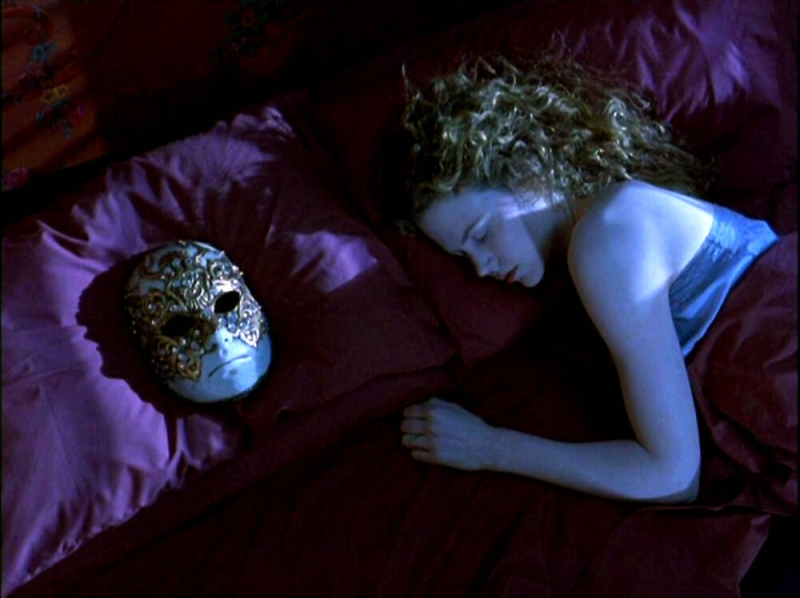
Image: Collected
Stanley Kubrick’s final film does not fade. More than a quarter-century after its release, Eyes Wide Shut (1999) still occupies a singular place in cinema—not merely as the last statement of a master, but as a work that continues to unsettle, provoke, and reward repeated viewing. It is a film that refuses easy summary or comfortable resolution. It lingers in the mind the way certain dreams do: vivid, ambiguous, and strangely insistent.
Adapted from Arthur Schnitzler’s 1926 novella Traumnovelle (Dream Story), the film transplants the story from fin-de-siècle Vienna to late-1990s New York. Dr. Bill Harford (Tom Cruise) and his wife Alice (Nicole Kidman) appear, at first, to inhabit a secure, affluent world. They attend a glittering Christmas party hosted by a wealthy patient, Victor Ziegler (Sydney Pollack). They flirt, dance, and return home. Then Alice, under the influence of marijuana, confesses a fantasy she once had about a naval officer—an admission so charged with desire and potential abandonment that it shatters Bill’s assumptions about their marriage and about women in general. What follows is a nocturnal odyssey through jealousy, temptation, ritual, and the limits of knowledge.
Bill’s journey takes him into encounters that hover between the erotic and the dangerous: a grieving daughter’s unexpected advance, a young prostitute, a former medical school classmate who has become a pianist for a secret society, and finally a masked orgy in a grand Long Island mansion. The film carefully blurs the line between what is real and what may be dream or projection. Alice, meanwhile, has her own dream—one far more explicit and humiliating for Bill—while he is out wandering. When the couple finally reunites, the film does not offer tidy catharsis. Instead it ends with a conversation in a toy store and one of the most memorable final lines in Kubrick’s career: Alice’s quiet, practical, and startlingly direct suggestion of what they need to do next.
A Film of Masks and Unknowability
At its core, Eyes Wide Shut is about the impossibility of fully knowing another person—even, or especially, the person one is married to. Marriage here is not a state of transparent intimacy but a negotiated coexistence with the other’s interior life, an interior that includes fantasies, resentments, and desires that may never be acted upon yet remain emotionally real. Alice’s confession does more damage than any physical betrayal because it reveals a private realm Bill cannot control or fully enter. His subsequent night of near-infidelities is less a pursuit of pleasure than an attempt to reclaim some sense of agency and knowledge.
The film is saturated with masks—literal ones at the orgy, social ones everywhere else. People perform roles: the successful doctor, the devoted wife, the worldly host, the available stranger. Kubrick shows how these performances sustain ordinary life while simultaneously concealing the currents of power, money, and desire that run beneath it. The secret society Bill briefly infiltrates is both theatrical and menacing; whether its threat is literal or a kind of elaborate scare tactic remains deliberately ambiguous. The film refuses to settle the question, leaving viewers in the same uncertain position as Bill himself.
Style as Substance
Kubrick’s direction is characteristically precise and deliberate. The long takes, the carefully composed frames, the recurring Christmas lights that give the city a dreamlike glow, the insistent piano motif from György Ligeti—all contribute to a hypnotic, slightly unreal atmosphere. The film moves at a measured pace that frustrates expectations of conventional erotic thriller mechanics. Many first-time viewers in 1999 felt the famous orgy sequence was strangely unerotic, even clinical. That was partly the point. Desire in Eyes Wide Shut is rarely simple or freely available; it is mediated by class, power, risk, and the fear of exposure.
The production itself became legendary. Principal photography lasted roughly 400 days—the longest continuous shoot in film history at the time—reflecting Kubrick’s obsessive perfectionism. Cruise and Kidman, then married, signed open-ended contracts and remained available for the duration. Kubrick died of a heart attack on March 7, 1999, only days after screening a near-final cut for the studio and the two stars. The film reached theaters that July. Debate has persisted about how “finished” it was, but the released version carries the unmistakable imprint of its director’s late style: cool, exacting, and deeply attentive to the gap between surface and depth.
Reception and Afterlife
Initial critical response was mixed, sometimes hostile. Some reviewers expected a steamy celebrity vehicle and found instead a slow, cerebral meditation. Others dismissed the orgy as tame or the New York locations as artificial (most exteriors were meticulously recreated at Pinewood Studios in England). Over time the reputation of Eyes Wide Shut has steadily risen. What once seemed frustrating or incomplete now reads as deliberate ambiguity. The film has been reappraised as one of Kubrick’s most personal works—a summation of long-standing interests in desire, power, masculinity, and the stories people tell themselves to remain functional.
Its cultural afterlife has been equally restless. Conspiracy theories have attached themselves to the orgy sequence with predictable fervor, reading it as coded revelation about real elite societies. More interestingly, the film continues to speak to contemporary anxieties about inequality, performative intimacy, and the private costs of public respectability. It remains a text that invites projection: different viewers find in it a critique of capitalism, a study of gender and jealousy, a Freudian dream narrative, or a surprisingly hopeful portrait of a marriage that survives the shock of mutual unknowability.
Why It Cannot Be Forgotten
Eyes Wide Shut endures because it refuses to look away from the uncomfortable truths of adult life. It suggests that fidelity is not the absence of fantasy but the ongoing choice to live with knowledge of fantasy’s power. It shows that social order depends, in part, on collective willingness to keep certain eyes shut. And it ends not with transcendence or destruction but with a pragmatic, embodied recommitment—two people deciding, imperfectly and without guarantees, to stay awake together.
Kubrick once described the film as his most important contribution to cinema. Whether one agrees with that ranking or not, the work has proven remarkably resistant to dismissal. Like the best of his films, it improves with time and attention. It is not a movie that settles into the background of cultural memory. It stays in the foreground—unsettling, elegant, and still asking the same difficult questions it posed in 1999. In that sense, the title is exact: once seen with open eyes, it is difficult to shut them again.