

- Oil Shock Sends Asian Markets Lower as Middle East Conflict Threatens Global Shipping |
- Trump Links Iran War to US Midterms, Backs United Ireland |
- PM Tarique Rahman Seeks Public Cooperation to Tackle Nationwide Dengue Outbreak |
- Jatiyatabadi Mahila Dal Vows to Lead Fight Against Rape, Violence Against Women and Children |
- 'Honorable' Dropped: PM Starts Implementing Decision from His Own Office |
Sluggish RMG exports unlikely to rebound in coming months
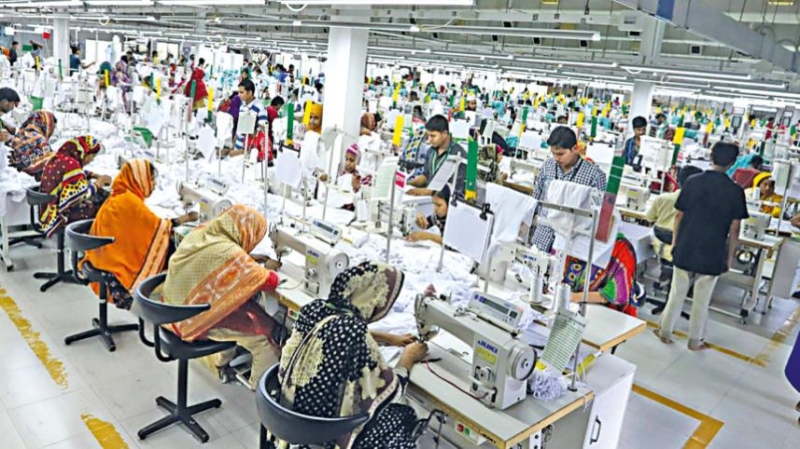
Photo: Collected
Bangladesh’s sluggish readymade garment (RMG) exports are unlikely to recover in the coming months as the prolonged Gulf war pushes up energy costs, fuels inflation in major Western markets and leaves retailers with growing inventories, according to exporters and international buyers.
Although uncertainty surrounding US tariffs has eased after the Trump administration maintained the newly announced 10 percent tariff, apparel buyers remain cautious and are placing fewer large orders. Exporters say the ongoing US-Israel war on Iran has created an energy shock that is affecting the global economy and weakening demand for clothing in key markets such as the US and Europe.
Bangladesh’s RMG sector earned $38.70 billion in FY26, down 1.64 percent from $39.35 billion in FY25, according to Export Promotion Bureau data. Exporters attribute the decline mainly to prolonged uncertainty over US tariffs, while also pointing to weak global demand, high oil prices and excess inventories.
The sector is also facing rising domestic production costs due to higher energy prices. Exporters have described the current situation as a “perfect storm”, while stressing that Western buyers are also struggling with difficult market conditions.
Industry leaders warn that Bangladesh’s heavy dependence on five basic garment categories—trousers, T-shirts, formal woven shirts, underwear and sweaters—has made the sector vulnerable to market saturation and intense price competition. These products account for 78 percent of total garment exports, while around 95 percent of factories produce them.
Exporters argue that Bangladesh must move towards higher-value and more diversified products to remain competitive in the global market. They also called for improved gas supplies and lower bank lending rates to help manufacturers manage rising production costs.
Industry experts say Vietnam currently holds a stronger position in the global supply chain because of stable production costs, greater value addition and shorter lead times to major markets.
A senior European garment retailer executive warned that Bangladesh may struggle to maintain $50 billion in RMG exports by 2030, much less achieve its $100 billion target, unless it diversifies its product range. He also cautioned that the loss of preferential market access following Bangladesh’s graduation from LDC status could make the country less competitive. Buyers have reportedly started considering alternative sourcing destinations ahead of the potential loss of GSP benefits.
The executive further warned that if India secures duty-free access to the European market through a bilateral FTA, Bangladeshi exporters could face greater pressure to reduce prices.
Meanwhile, the BGMEA plans to organise roadshows in the US, Japan and South Africa in the coming months to help revive export orders. The organisation is also establishing a design studio to support exporters by analysing market trends, products and the latest fashion developments.