

- Arson Attempt Foiled as Staff Quench Fire on Mirpur Bus |
- Personalized mRNA Melanoma Vaccine Intismeran Hits Major Milestone, Cutting Recurrence Risk by 42% in Landmark Phase 3 Trial |
- City govt essential for planned development of Chattogram: CCC administrator |
- Asian Stocks Slump After US Tech Rout Amid AI Jitters |
- Free Concert Featuring James and Seven Bands Set for Manik Mia Avenue |
IMF and Central Bank Leaders Weigh AI’s Economic Promise and Risks
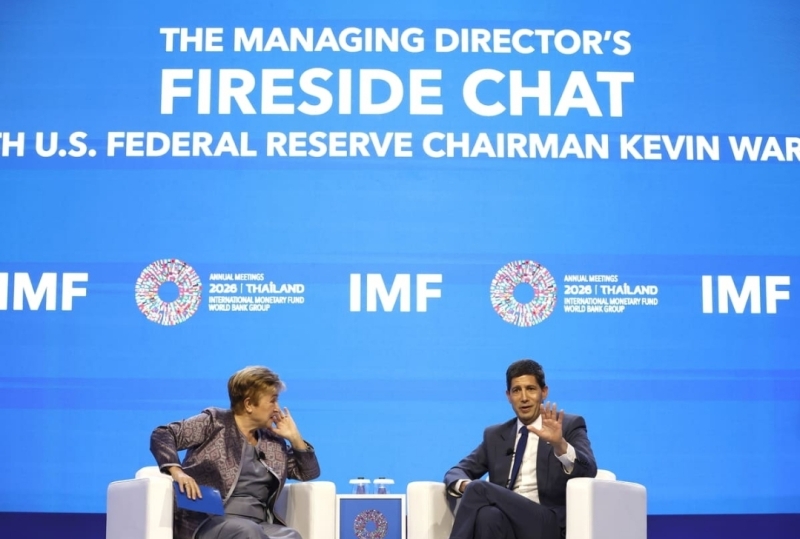
Image: Collected
Artificial intelligence is emerging as both a powerful engine of global growth and a potential source of financial instability, according to leading policymakers at the IMF and World Bank Annual Meetings in Bangkok.
Federal Reserve Chair Kevin Warsh called AI “probably the most consequential change” to the U.S. and global economies in his lifetime. But he cautioned that the path to those gains would be “very bumpy,” speaking in a fireside chat with IMF Managing Director Kristalina Georgieva on Friday, October 16.
Warsh Sees a ‘Bumpy’ Path
Warsh said AI would reshape the real economy, although its short-term effects remain uncertain. “We don’t know in the next 12 or 18 months its effect on employment,” he said.
He expects the technology to influence demand first and supply later. Over the medium term, he predicted a supply shock and “a huge benefit to the global economy, to the U.S. economy.”
The turbulence, he argued, would come from gaps in understanding and uncertainty over market structure. “We really don’t know what the market structure is going to be,” Warsh said.
He also urged central bankers to treat AI investment as an economic shock. The surge in spending on AI infrastructure is lifting demand, adding pressure to an economy already facing elevated energy prices. Warsh gave no indication of the Federal Reserve’s next interest-rate decision, expected on October 28.
IMF Flags Stability Risks
Georgieva warned that confidence could prove decisive. “If there is loss of confidence and money runs away from AI, that can lead to financial stability risks,” she told AFP. “Any slowdown would be felt across the world.”
The IMF’s October 2026 Global Financial Stability Report, released on Tuesday, October 13, found that an unwinding of the AI investment boom could reduce global GDP by 0.4 percent by 2028 and global investment by 1.3 percent.
“Weaker or less durable AI investments and profitability could be a shock that triggers a market correction,” the report said.
AI-related spending has so far helped offset the economic damage from high energy prices linked to war in the Middle East. IMF chief economist Silvana Tenreyro said global trade grew 8.3 percent between 2023 and 2025, but would have expanded by only about 4.6 percent without AI-related products.
Economists at Moody’s Analytics warned that a prolonged conflict could “puncture” the AI boom, exposing the fragility of growth that depends heavily on a narrow set of technology investments.
Standing on ‘One Leg’
Regulation featured prominently in the Bangkok discussions. Georgieva said safeguards are essential to ensure that AI’s benefits outweigh its dangers.
“If there are no safeguards, then the risks may exceed the opportunities,” she said.
As the annual meetings closed on Saturday, Georgieva described the prevailing mood as one of “optimism and worry.” She said relying on AI as a primary driver of growth leaves the world economy vulnerable.
“It is like we stand on one leg,” she said.