

- City govt essential for planned development of Chattogram: CCC administrator |
- Asian Stocks Slump After US Tech Rout Amid AI Jitters |
- Free Concert Featuring James and Seven Bands Set for Manik Mia Avenue |
- Garment factories reopen as workers return to work in Savar-Ashulia |
- Trump confirms new US strikes on Iran’s Qeshm island |
One Torah, Many Interpretations: The Main Branches of Judaism and Their Core Values Compared with Christianity and Islam
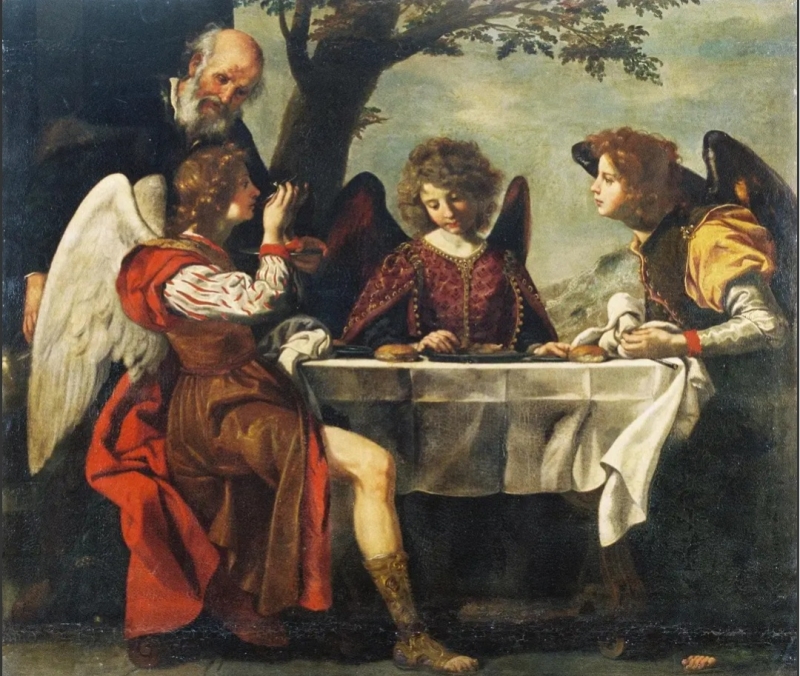
Image: Abraham and Three Angels (first half of the 17th century), attributed to the Italian Baroque painter Jacopo Vignali (1592–1664).
Judaism is often described as one of the world’s oldest monotheistic religions, but it is far from a single, unchanging tradition. Across the world, Jewish communities follow different movements that share core beliefs in one God, the Torah, and the covenant with the Jewish people, yet differ sharply over how Jewish law should be observed and how tradition should adapt to modern life.
At the heart of all Jewish movements is the idea that faith is expressed through action. Jewish teachings emphasize justice, compassion, study, family responsibility, and the repair of the world—known as tikkun olam. For many Jews, being religious is not only about belief in God but also about building an ethical society and treating other people with dignity.
Orthodox Judaism represents the most traditional wing of the faith. Orthodox Jews generally view the Torah and rabbinic law, known as halakhah, as binding in daily life. This often includes strict observance of the Sabbath, kosher dietary rules, traditional prayer, and clearly defined gender roles in religious settings. The central value is continuity: preserving the covenantal way of life passed down through generations.
Within Orthodoxy, however, there are important differences. Haredi, or ultra-Orthodox, communities tend to maintain a strong separation from secular culture and prioritize religious study and traditional living. Modern Orthodox Jews, by contrast, combine strict religious observance with engagement in higher education, professional life, and wider society.
Conservative Judaism seeks a middle path. It respects traditional Jewish law and ritual but accepts that religious practice can develop through historical study and changing circumstances. Conservative Jews may observe the Sabbath, kosher laws, and traditional prayers, while allowing more flexibility than Orthodox communities. Its core value is balance: honoring the past without ignoring the realities of modern life.
Reform Judaism takes a more adaptive approach. It treats many ritual laws as optional or open to personal interpretation, placing greater emphasis on individual conscience, equality, inclusion, and social justice. Reform communities often use more egalitarian prayer practices and encourage members to shape their religious lives in dialogue with modern ethical values.
Reconstructionist Judaism goes further in presenting Judaism as an evolving civilization rather than simply a set of divine commandments. It sees Jewish culture, language, history, and communal decision-making as central to religious identity. For Reconstructionist Jews, tradition remains valuable, but it is shaped by the community rather than accepted as unchanging law.
These differences matter because they show that Judaism is not divided merely over ritual. Orthodox Jews may prioritize obedience to divine commandments, while Reform and Reconstructionist Jews often emphasize personal meaning, equality, and ethical responsibility. Conservative Jews try to preserve tradition while allowing it to evolve. Despite these disagreements, all remain connected by the Torah, Jewish history, and a shared sense of peoplehood.
Judaism also differs in significant ways from Christianity and Islam, its fellow Abrahamic religions. All three believe in one God and trace their spiritual heritage to Abraham, but they understand revelation, salvation, and religious identity differently.
Christianity centers on Jesus Christ, whom Christians regard as the savior and, in most traditions, part of the Trinity. Judaism rejects the idea that God became human and maintains a strict understanding of divine unity. Islam also rejects the Trinity and emphasizes tawhid, the absolute oneness of God, while recognizing Muhammad as its final prophet.
The religions also differ in their central texts and paths of faithfulness. Judaism follows the Tanakh, especially the Torah, alongside rabbinic teachings; Christianity follows the Bible, including the New Testament; and Islam follows the Qur’an along with the Hadith and Sunnah. For Jews, faithfulness is closely tied to covenant, commandments, study, and justice; for Christians, it often centers on faith in Christ and salvation through grace; for Muslims, it centers on submission to God through the Five Pillars and Islamic law.
Perhaps the most distinctive feature of Judaism is that it is both a religion and the culture of a people. Unlike Christianity and Islam, which are universal missionary faiths open to converts from all backgrounds, Judaism centers on the covenant between God and the Jewish people. At the same time, Jewish teaching recognizes God as the God of all humanity, not only of Jews.
In the end, Judaism’s internal diversity reflects a tradition that has survived exile, persecution, modernization, and cultural change. Orthodox, Conservative, Reform, and Reconstructionist Jews may disagree over law, ritual, and authority, but they share a deeper commitment to memory, community, justice, and the belief that daily life can be made holy through ethical action.