

- City govt essential for planned development of Chattogram: CCC administrator |
- Asian Stocks Slump After US Tech Rout Amid AI Jitters |
- Free Concert Featuring James and Seven Bands Set for Manik Mia Avenue |
- Garment factories reopen as workers return to work in Savar-Ashulia |
- Trump confirms new US strikes on Iran’s Qeshm island |
Bangladesh-US trade reaches $12.67b as imports narrow surplus
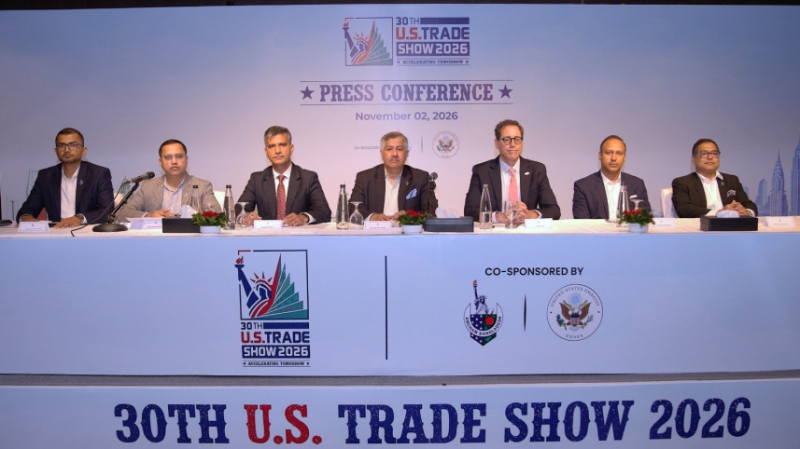
Image- Collected
Bangladesh’s merchandise trade with the United States totalled $12.67 billion in FY26, with a sharp increase in imports reducing the country’s trade surplus, Speaker Hafiz Uddin Ahmed said on Thursday.
Quoting National Board of Revenue (NBR) figures, he said the US had become Bangladesh’s second-largest trading partner after China and remained its biggest export market among individual countries.
The expanding trade relationship follows a reciprocal trade agreement signed by Bangladesh and the US on February 9. Under the deal, Washington lowered its reciprocal tariff on Bangladeshi goods from 20% to 19% and agreed to develop a mechanism for zero reciprocal tariffs on certain textile and apparel products made using US-produced materials.
Bangladesh, in return, committed to offering preferential market access to various American industrial and agricultural products and increasing purchases of US goods, including agricultural commodities and energy supplies.
NBR data show that Bangladesh exported goods worth $9.11 billion to the US in FY26, while imports from the country amounted to $3.56 billion. This left a trade surplus of $5.55 billion, compared with $6.26 billion in FY25, as imports increased faster than exports.
The Speaker made the remarks at the opening of the 30th US Trade Show, organised by the American Chamber of Commerce in Bangladesh (AmCham) at a hotel in Dhaka.
He encouraged US companies to consider investing in Bangladesh’s energy sector, particularly in oil and gas exploration along the coast and in the Bay of Bengal.
The government has already invited international tenders for exploration, he said, expressing confidence in the country’s potential hydrocarbon resources.
Referring to gas reserves on an island in his electoral constituency of Bhola, Hafiz Uddin said more than seven trillion cubic feet (TCF) of gas had been proven there. He also expressed hope that further exploration in coastal areas and the Bay of Bengal would uncover oil and gas deposits, pointing to discoveries in neighbouring Myanmar.
Environment, Forest and Climate Change Minister Abdul Awal Mintoo said stronger commercial cooperation was necessary to deepen relations between Bangladesh and the US, adding that political ties alone were no longer enough.
He said the government was working to improve the investment climate and encourage American companies to establish manufacturing facilities in Bangladesh, rather than limiting their involvement to investment.
A one-stop service is also being introduced to simplify the process of securing licences and regulatory approvals. The minister said the government would assist American companies facing operational challenges.
US Ambassador to Bangladesh Brent T Christensen said the Trump administration was focused on expanding opportunities for American businesses, supporting US workers and increasing exports.
He described the reciprocal trade agreement as an important framework for strengthening economic relations but said its success would depend on effective implementation.
The ambassador stressed the need for transparent procurement, prompt payments, consistent policies and fewer tariff and non-tariff barriers. He also highlighted the importance of protecting labour rights and ensuring fair competition to make Bangladesh more attractive to responsible investors.
According to Christensen, Bangladesh’s demand for energy, technology, industrial goods, healthcare, agricultural products and infrastructure development offers considerable opportunities for American businesses.
AmCham’s president said US companies had invested nearly $5 billion in Bangladesh. The chamber also pledged an additional $5 billion in investment over the next five years during a meeting with the prime minister on August 11.
He said further investment would depend on a favourable business environment, identifying energy security as a major concern for investors.
AmCham has 270 members and contributes around 22% of Bangladesh’s total tax revenue, he added.
The three-day US Trade Show, jointly organised by AmCham and the US Embassy, will run until November 7 at the InterContinental Dhaka.
The event has returned after a gap of around two and a half years, featuring 43 exhibitors, including 36 companies and seven startups, across 63 booths.
Participating US companies and brands include Caterpillar, Chevron, ExxonMobil, MetLife, Citigroup, Mastercard, Visa, Colgate-Palmolive, Philip Morris International, PepsiCo, Costco Wholesale, PPG, UPS and Cargill.
The exhibition has seven dedicated zones, including a carnival hall showcasing US products, a heritage corner and a startup zone.