

- City govt essential for planned development of Chattogram: CCC administrator |
- Asian Stocks Slump After US Tech Rout Amid AI Jitters |
- Free Concert Featuring James and Seven Bands Set for Manik Mia Avenue |
- Garment factories reopen as workers return to work in Savar-Ashulia |
- Trump confirms new US strikes on Iran’s Qeshm island |
25 more garment factories declare holidays amid unrest in Gazipur
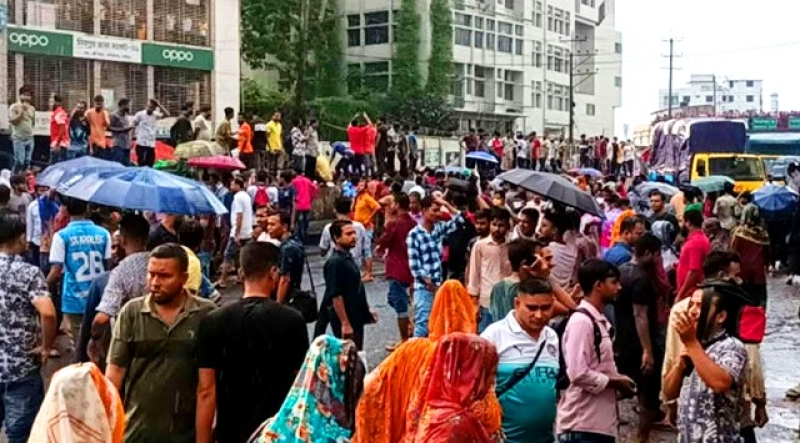
Photo: collected
Authorities have declared holidays at 20 to 25 more garment factories across Gazipur amid continuing worker unrest, as protests, road blockades and clashes with police raised concerns over the security of the country's garment industry.
The factory holidays were announced on Tuesday to prevent further violence and damage. However, the overall situation across the industrial hub remained normal until 9:30am, Gazipur Industrial Police-2 Superintendent Mohammad Amjad Hossain said.
He said workers from several factories arrived for their shifts in the morning, while some attempted to block the Dhaka-Tangail and Dhaka-Mymensingh highways and stage demonstrations in Naojor, Bhogra, Konabari, Mouchak, Shafipur and Palli Bidyut.
Police quickly cleared the roads, he said, adding that authorities had declared holidays at 20 to 25 factories in different areas to prevent further unrest.
Some workers were still seen gathering on smaller roads. Police deployment and patrols had been increased at key points across the industrial belt.
Meanwhile, Gazipur Superintendent of Police Mohammad Jasim Uddin dismissed social media claims that a school student had been injured or killed by police firing during the garment workers' protests.
He said police had not fired on workers and no student had been shot. A public notice was issued to prevent the spread of misinformation, he added.
The protests, centred on demands for a minimum monthly wage of Tk 30,000, have involved road blockades, factory vandalism and arson in several industrial areas over recent days. Police officers, journalists and others have been injured, while vehicles, including police cars, and factory warehouses have been set on fire.
In Dhaka's Mirpur, clashes and chases broke out between garment workers and police on Tuesday as demonstrations spread through the Mirpur-11 area.
Police fired tear gas and sound grenades to disperse protesters. Separate incidents of attacks on police officers were reported on Kalshi Road in Pallabi, while two people were detained in connection with the unrest.
The Mirpur-11 metro rail station was temporarily closed for passenger safety, the MRT Police Control Room confirmed on Tuesday morning.
Industry leaders warn of mounting losses
The prolonged unrest has heightened concerns among garment industry owners, who say vandalism, arson, looting and road blockades are threatening production, exports and factory infrastructure.
Entrepreneurs fear continued instability could undermine the confidence of foreign buyers and encourage them to shift orders to competing countries.
The labour unrest, which has continued for about a month over wage demands, has turned increasingly violent over the past week.
Fazlul Hoque, administrator of the Federation of Bangladesh Chambers of Commerce and Industry (FBCCI) and former president of the Bangladesh Knitwear Manufacturers and Exporters Association (BKMEA), said the industry was already struggling with declining profits and rising operating costs.
He cited gas and electricity shortages, high bank lending rates, inadequate banking support and weak international markets as major challenges. Electricity prices had also increased by 16 percent, adding to the pressure on businesses.
Despite these difficulties, entrepreneurs were trying to keep factories running while protecting workers' interests, he said.
Hoque questioned whether groups outside the officially involved parties were instigating the violence and called on intelligence agencies and law enforcement authorities to investigate possible third-party involvement.
He also questioned the continuation of protests following the formation of a wage board, saying the government had established the panel within a short time under the prescribed process.
The board includes representatives of workers, factory owners, the government and neutral parties. Hoque said it should be allowed to complete its work and submit recommendations before further action was considered.
He said workers' demands for higher wages and owners' ability to sustain their businesses both needed consideration.
The wage board would review the issues and propose a settlement, followed by opportunities for discussion and adjustment, he said.
Vandalism and arson were unacceptable, Hoque added, saying such incidents were hurting workers, entrepreneurs and the wider economy.
Former Bangladesh Garment Manufacturers and Exporters Association (BGMEA) director Shovon Islam also questioned the rationale for continued protests after the wage board was formed.
He said factory owners were increasingly helpless as outsiders were allegedly encouraging workers to leave factories, including establishments with no history of labour unrest or salary payment problems.
Shovon said attacks on factories, vehicles and buses, along with incidents involving crude bombs and arson, went beyond legitimate labour protests.
He claimed crude bombs had been found in several factories, with some facilities targeted by explosions and fires.
Shovon also said labour federation leaders had given positive assurances after meeting the labour minister but appeared unable to control workers on the ground.
He called for stronger security measures, saying the number of law enforcement personnel deployed remained inadequate and BGB deployment had been slow.
The garment industry had already faced a difficult year because of US President Donald Trump's tariff policies, global economic uncertainty, higher fuel and gas prices, and energy shortages, he said.
Entrepreneurs had struggled to keep factories operational amid oil and gas supply disruptions over the past week. The latest violence was further damaging Bangladesh's reputation among international buyers, he added.
Shovon warned that buyers needed guarantees of uninterrupted production and timely deliveries. If instability continued, they could shift orders to other countries, even at slightly higher costs, putting Bangladesh's export market share at risk.