

- City govt essential for planned development of Chattogram: CCC administrator |
- Asian Stocks Slump After US Tech Rout Amid AI Jitters |
- Free Concert Featuring James and Seven Bands Set for Manik Mia Avenue |
- Garment factories reopen as workers return to work in Savar-Ashulia |
- Trump confirms new US strikes on Iran’s Qeshm island |
Tk1,500 crore green fund to support rooftop solar projects
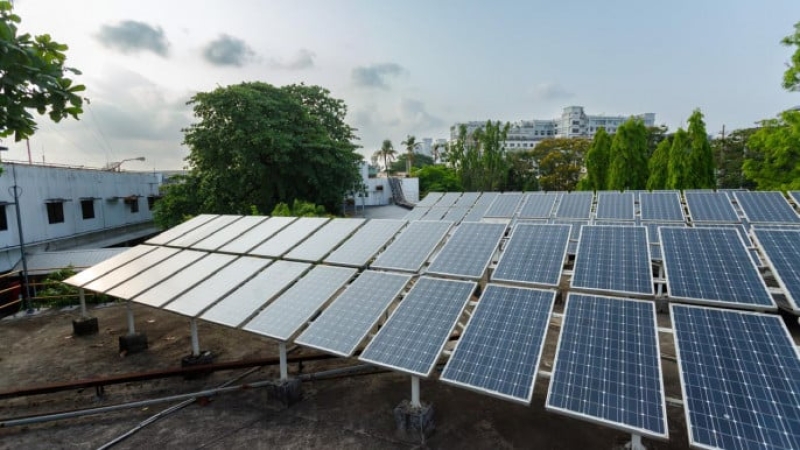
Representational image- Collected
The government has set aside Tk1,500 crore from existing green financing resources to support rooftop solar projects, offering entrepreneurs loans at interest rates of up to 6% with repayment periods of 12 years.
The funding will be drawn from the Bangladesh Bank’s Green Transformation Fund (GTF) and distributed through three institutions: Infrastructure Development Company Limited (IDCOL), Bangladesh Infrastructure Finance Fund Limited (BIFFL) and Palli Karma-Sahayak Foundation (PKSF). The government aims to expand rooftop solar installations without financing individual projects directly.
IDCOL has already received Tk500 crore from the initial allocation. BIFFL and PKSF will also receive funds to support investments in rooftop solar systems.
Power Secretary Mirana Mahrukh told The Business Standard that the government had mobilised the Tk1,500 crore from existing green funds and resources originally intended for low-carbon activities, rather than providing fresh money from the national treasury.
She said additional funding could be released in phases, potentially including another Tk500 crore once the initial allocation has been used.
Under the proposed financing model, private investors will provide 20% of a project's total cost, while rooftop owners will contribute another 20%. The remaining 60% will be available as loans through the designated financial institutions.
The arrangement is intended to give rooftop owners a direct financial stake in the installations, encouraging them to take responsibility for maintaining the systems.
Amid concerns over recurring summer power shortages, the Power Division is working to install 3,000–4,000MW of rooftop solar capacity by next February. The initiative is also intended to reduce reliance on fossil fuel-based power plants as fuel costs rise amid the Iran-US conflict.
As part of the effort, the Power Division and Idcol are organising a two-day solar expo on November 3–4. Prime Minister Tarique Rahman is scheduled to inaugurate the event.
Imran Karim, chairman of Confidence Power and Energy PLC, welcomed the low-interest financing initiative. He said increased investment in solar energy was necessary to strengthen Bangladesh’s energy security alongside grid-scale and sub-grid-scale projects.
He described the 12-year repayment facility as a positive step but stressed the importance of recovering loans properly, ensuring transparent use of funds and passing benefits on to consumers. He also called for consultations with stakeholders to develop a clear standard operating procedure for implementation.
International and domestic lenders show interest
The government is seeking additional financing from international development partners and commercial banks to expand the programme.
The World Bank has committed $500 million, which Bangladesh expects to receive by March, subject to the ongoing process. The proposed funding would combine several sources, including climate and green financing facilities.
The Asian Infrastructure Investment Bank (AIIB) has also made an initial commitment of $500 million, which is being processed.
Power Division officials said financing from these institutions could be relatively expensive. The government is therefore exploring a mix of funding sources to reduce the overall cost of loans.
Discussions are also underway with international and domestic commercial banks, including HSBC, Citi and BRAC Bank. These institutions have expressed interest in providing affordable financing for rooftop solar projects.
According to the Power Division, private banks are considering loans at around 5%, potentially bringing more funding into the programme from the domestic market.
The Asian Development Bank (ADB) has also begun discussions with Bangladesh on establishing a financing platform involving multiple development partners. It is considering an initial contribution of $250 million, with the platform potentially expanding to mobilise billions of dollars.
The power secretary said the government was working to combine funds from different sources, particularly lower-cost financing, to develop affordable loan products for different categories of rooftop solar users.
IDCOL has also been instructed to develop financing packages suited to different types of installations.
Equipment standards and quality control
Alongside financing, the government is taking steps to ensure that imported solar panels, batteries and other equipment meet technical standards, amid concerns over substandard products entering the market.
The Bangladesh Standards and Testing Institution (BSTI) has been brought into the initiative and given specific technical requirements for solar equipment. Idcol has also issued specifications that financing institutions must follow before approving loans.
Importers will have to provide undertakings about the products they bring into the country. The National Board of Revenue (NBR) has also been involved in monitoring imports and checking whether equipment meets the required standards during customs clearance.
As legal restrictions prevent authorities from specifying particular brands or countries of origin for solar panels and battery storage systems, the Power Division has set strict technical requirements for solar modules. These include quality benchmarks comparable to those followed by major manufacturers such as Jinko Solar and LONGi.
The division has also assigned six engineers from the Bangladesh Power Development Board to BSTI to strengthen its technical capacity. They have completed specialised seven-day training to help monitor compliance with equipment standards.
The Power Division is also working on insurance arrangements to protect solar installations against natural disasters. However, rooftop owners will remain responsible for losses caused by theft.