

- City govt essential for planned development of Chattogram: CCC administrator |
- Asian Stocks Slump After US Tech Rout Amid AI Jitters |
- Free Concert Featuring James and Seven Bands Set for Manik Mia Avenue |
- Garment factories reopen as workers return to work in Savar-Ashulia |
- Trump confirms new US strikes on Iran’s Qeshm island |
Govt plans major solar power expansion before next summer
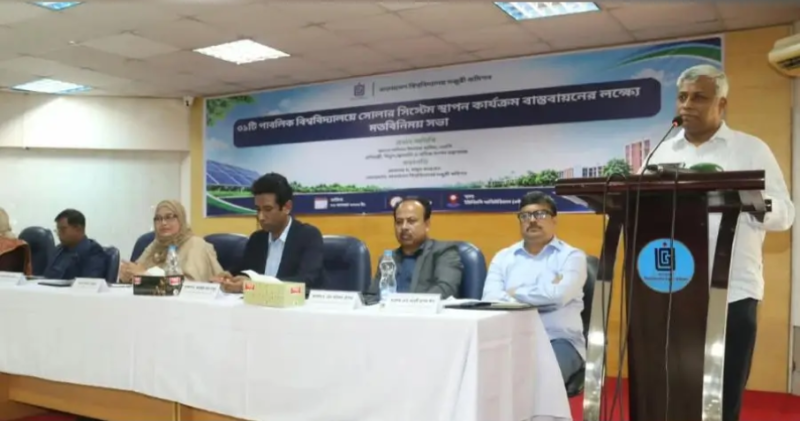
Image- Collected
Bangladesh aims to add 3,000 to 4,000 megawatts of solar-generated electricity before next summer to help limit the impact of power shortages, State Minister for Power, Energy and Mineral Resources Aninda Islam Amit said on Monday.
The government is looking at rooftop solar installations as a practical means of reaching the target, he said at a meeting organised by the University Grants Commission (UGC) at its Agargaon office.
Amit said the initiative was intended to prevent a repeat of the difficulties consumers experienced during the previous summer because of inadequate electricity supply.
He added that the government had prepared a policy to accelerate solar power adoption within two months. The framework could be updated after receiving feedback from relevant stakeholders.
On plans to install solar systems at public universities, the state minister clarified that institutions would not be compelled to adopt the technology. Each university would be able to decide based on its requirements and financial and technical capacity.
He also said the Power Division would assist universities in obtaining carbon credits by cutting greenhouse gas emissions through solar electricity generation.
UGC Chairman Professor Dr Mamun Ahmed said a survey had already been completed and a team formed to examine the prospects of installing solar systems at 31 public universities.
According to him, universities could start the process within a month if they took the necessary initiatives without delay. The UGC would provide technical assistance to support the work.
Mamun Ahmed also advocated the operational expenditure (OPEX) model as a way to lower electricity bills at universities. He pointed to an initiative at Jashore University of Science and Technology as an example of this approach.
Vice-chancellors from public universities, senior Power Division officials and UGC members also attended the meeting.