

- City govt essential for planned development of Chattogram: CCC administrator |
- Asian Stocks Slump After US Tech Rout Amid AI Jitters |
- Free Concert Featuring James and Seven Bands Set for Manik Mia Avenue |
- Garment factories reopen as workers return to work in Savar-Ashulia |
- Trump confirms new US strikes on Iran’s Qeshm island |
Brazil's Lula wins 4th term as Trump ally Bolsonaro rejects election result
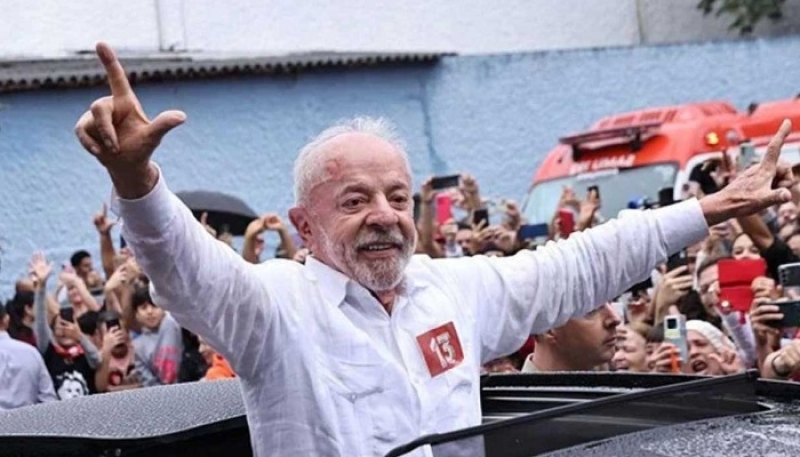
Photo: collected
Brazilian President Luiz Inácio Lula da Silva won a historic fourth term on Sunday, defeating Senator Flávio Bolsonaro, an ally of US President Donald Trump, who rejected the result and vowed to challenge it in court.
The 80-year-old leftist leader secured more than 51% of the vote in the runoff, overcoming concerns over the cost of living, crime and corruption to buck a broader rightward shift in Latin America.
Bolsonaro, who trailed Lula by about 4.4 million votes, said his team would challenge the result after the Supreme Court extended voting by two hours.
“It is impossible to recognize the election result given how these events unfolded,” Bolsonaro told supporters in Brasilia after Lula's victory was declared.
“We will take legal action. We will ask for this election to be annulled.”
Lula said his government would give Brazilians a greater role in decision-making.
“I can assure you that we are going to change the way we govern this country. We are going to give the people a greater role in our decisions,” he said.
He thanked Brazilians for their “generosity”, particularly young people who “took to the streets to defend democracy”.
Supporters celebrated in Rio de Janeiro and Belo Horizonte, chanting, singing and raising the “L” sign.
The result marked a major setback for the Bolsonaro political movement. Flávio failed to achieve what his father, former President Jair Bolsonaro, also failed to do in 2022: defeat Lula at the ballot box. Jair Bolsonaro is serving a prison sentence for attempting to overturn his 2022 election defeat.
The election day was marked by controversy after voting was extended by two hours following requests from both campaigns.
Supreme Court Justice Cristiano Zanin granted a request from Lula's campaign, which cited disruptions affecting buses transporting voters to polling stations in several states.
Bolsonaro's campaign also sought an extension in some areas, citing heavy rain that made it difficult for voters to reach polling stations. The order was issued at about 5 pm in Brasilia, when polls were due to close and some stations had already shut.
The outcome has implications beyond Brazil, Latin America's largest economy. Lula has pursued a more independent foreign policy, emphasising national sovereignty and closer ties with China and the Global South amid tensions with Washington.
Before polls closed, Trump said he was “monitoring” the runoff. He did not endorse either candidate but had previously praised Flávio's first-round performance and described the election as “very important”.
According to Brazil's Superior Electoral Court, Bolsonaro secured 2.2 million more votes than Lula in the first round. Neither candidate won an outright majority, forcing both campaigns to compete for undecided voters in a deeply divided country.
The first-round result exposed weaknesses in Lula's campaign, including public frustration over living costs and crime. It also showed the continued strength of Jair Bolsonaro's political movement despite his imprisonment.
The outcome came amid a broader rightward shift in Latin America, where elections since April 2025 in Ecuador, Bolivia, Honduras, Chile, Costa Rica, Colombia and Peru had produced victories for right-wing or centre-right candidates.
A July Datafolha survey found that 44% of Brazilians leaned right or centre-right in their political values, compared with 39% who leaned left or centre-left, reversing the balance recorded in 2022.
Despite that trend, Lula prevailed in the runoff.
Public safety was a central campaign issue. A September Quaest/Pax survey found that 28% of Brazilians considered violence the country's biggest problem, followed by corruption at 22% and the economy at 19%.
Flávio pledged to designate major criminal factions as terrorist groups, expand prisons and lower the age of criminal responsibility.
“Those who think I'm radical on public security haven't seen anything yet,” he said on October 13, adding that even El Salvador's hardline approach under President Nayib Bukele was insufficient.
Lula struggled to reconcile his party's traditional positions with demands for tougher action against crime. A widely circulated clip of him saying last year that drug traffickers were also victims of drug users reinforced what Brian Winter, editor-in-chief of Americas Quarterly, called a “longstanding perception that the Brazilian left is soft on crime”. Lula later acknowledged that he had expressed himself poorly.
The economy and affordability also weighed on Lula's campaign. During his first two terms, a commodities boom helped lift millions of Brazilians out of poverty and into the middle class.
This time, many voters said they had seen little progress. Lula could point to low unemployment and easing inflation, but households continued to struggle with everyday costs.
Winter compared the dynamic with the 2024 US presidential election, when favourable economic statistics failed to overcome frustration over prices under President Joe Biden and then-Vice President Kamala Harris.
Many voters nevertheless remained loyal to Lula because of the social gains made during his first two terms and fears that a Bolsonaro presidency could roll back social rights. Flávio sought to address those concerns by distancing himself from some traditionally conservative positions.
The association of the left with corruption has contributed to the political shift in Brazil, although allegations have shadowed both campaigns.
During a debate last Sunday, Lula challenged Flávio to disclose his financial records and questioned his ties to Daniel Vorcaro, the former head of collapsed Banco Master. Alleged connections involving powerful figures have embroiled Brazil's political and judicial establishment, including the Supreme Court.
Flávio accused Lula of corruption and raised allegations involving the president's eldest son, known as Lulinha. Lula's previous corruption convictions were annulled in 2021.
The allegations have deepened public frustration with politics, experts said.
“It reinforces the disgust and apathy that Brazilians feel with their political system as a whole,” Winter told the media.
Source: CNN