

- City govt essential for planned development of Chattogram: CCC administrator |
- Asian Stocks Slump After US Tech Rout Amid AI Jitters |
- Free Concert Featuring James and Seven Bands Set for Manik Mia Avenue |
- Garment factories reopen as workers return to work in Savar-Ashulia |
- Trump confirms new US strikes on Iran’s Qeshm island |
CEC flags low number of female candidates in local govt polls
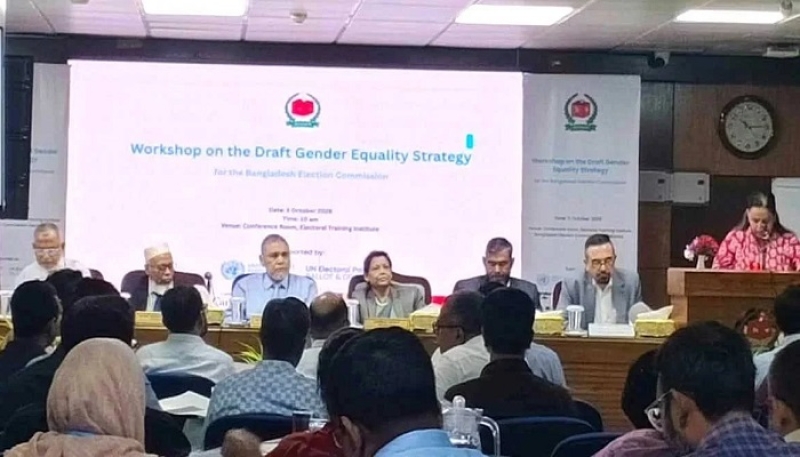
Photo - Collected
Bangladesh's chief election commissioner A. M. M. Nasir Uddin said on Monday he expected high turnout among female voters in upcoming local government elections but warned that the number of female candidates could be low.
"Female participation is an essential component of democracy," Nasir Uddin said at a workshop on gender equality in the electoral process.
He said stronger institutions, greater public awareness, large-scale campaigns and data-driven policies were needed to increase women's participation.
"There will be a huge participation of female voters in the upcoming local government elections. However, female candidates will be fewer," he said, citing social culture and traditional beliefs as factors.
"People do not accept change easily. If we want to bring about change, we think ten times. That is why awareness is needed, and large campaigns must be conducted. Keeping half of the population outside, we cannot consolidate democracy. For a credible democracy, female participation must be increased," he said.
The workshop, held at the Election Commission's Electoral Training Institute, reviewed a draft Gender Equality Strategy and sought stakeholder views before its finalisation. It was organised with assistance from UN Bangladesh and its Electoral Project BALLOT & DRIP.
On increasing women's participation, Nasir Uddin said: "It is difficult to bring change here. For this, awareness activities must be conducted on a massive scale. Data-driven policies must be formulated to increase female participation."
UN Women Country Representative Gita Sabharwal (Gitanjali Singh) said financial, social and technological barriers to women's participation in elections needed to be removed.
Election Commissioner Abul Fazal Md. Sanaullah said women had many opportunities to participate in Bangladesh's democratic process, including reserved seats in local government.
"Regrettably, female candidates were few in the last national election. If women's participation in party and political decision-making processes can be increased, the number of candidates will also increase," he said.
Sanaullah also called for measures to counter fake news and disinformation targeting women on social media.
Election Commissioner Anwarul Islam Sarkar said the registration process for female voters should be simplified and harassment of female voters and candidates stopped. He also called for equal opportunities for female candidates.
Election Commissioner Tahmida Ahmed said laws protecting women's rights and security were not enough without effective implementation and good governance.
"Formulating a strategy sitting in a five-star hotel will not yield results. We have to go to the root of the problem; we have to go to the villages," she said.
Election Commissioner Abdur Rahmanel Masud said Bangladesh had strong laws to protect women, but legislation alone could not ensure women's rights and needed to be accompanied by social change.