

- City govt essential for planned development of Chattogram: CCC administrator |
- Asian Stocks Slump After US Tech Rout Amid AI Jitters |
- Free Concert Featuring James and Seven Bands Set for Manik Mia Avenue |
- Garment factories reopen as workers return to work in Savar-Ashulia |
- Trump confirms new US strikes on Iran’s Qeshm island |
Female Worker Migration Increases, But Remains Concentrated in Two Countries
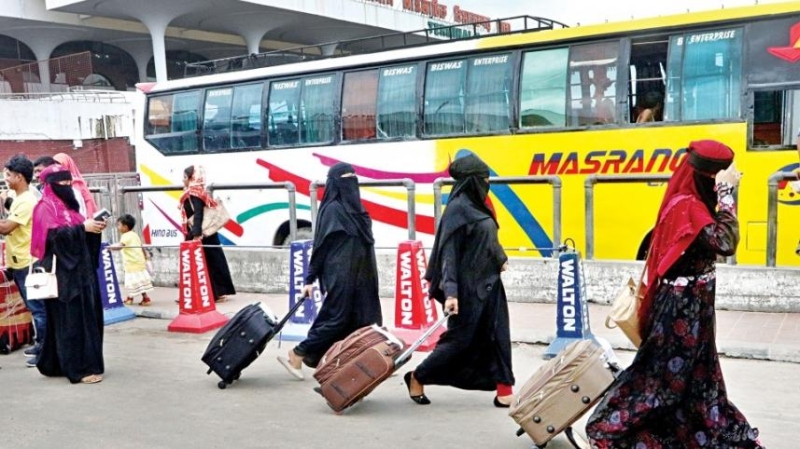
Image- Collected
More than 42,000 Bangladeshi women migrated abroad for employment during the first eight months of 2026, with more than 90 percent heading to Saudi Arabia and Jordan. The figures show that female overseas employment remains heavily concentrated in a small number of destinations and largely dependent on domestic work.
According to the Bureau of Manpower, Employment and Training (BMET), 105,466 Bangladeshi women went abroad for work in 2022. That figure fell to 62,317 in 2025, marking a decline of nearly 41 percent. However, female worker migration rose by around 14 percent in the first eight months of 2026 compared with the same period last year.
Despite the recent increase, returning workers and migration organisations continue to report serious difficulties faced by female migrants. These include physical and psychological abuse, sexual harassment, excessive working hours, poor food and unpaid or irregular wages.
Many women also leave the country without adequate language or job-specific training. Some reportedly find themselves working in several households despite being recruited for a single position. Such experiences are contributing to growing reluctance among women to pursue overseas employment.
A study by the Ovibashi Karmi Unnayan Program (OKUP) found that 94 percent of female workers who returned involuntarily had experienced regular physical and psychological abuse. The study also found that 47 percent had faced sexual harassment, while 82 percent were required to work from early morning until midnight.
The government says it has introduced legal assistance in 13 countries and operates a safe house in Saudi Arabia to provide support to female migrant workers. It is also seeking to expand employment opportunities in skilled sectors, including caregiving and housekeeping, in countries such as Japan and Hong Kong.
Migration experts say Bangladesh needs to move beyond its heavy reliance on domestic work by diversifying employment opportunities and ensuring proper training, legal protection and safe working conditions for women before they migrate.
Organisations supporting returning migrants point to countries such as Nepal, Indonesia, the Philippines and Vietnam, which have adopted stronger measures to protect migrant workers, including suspending worker deployment when necessary. They argue that Bangladesh needs similar safeguards and greater diversification of overseas employment opportunities to prevent more women from becoming discouraged from migrating for work.